
Description
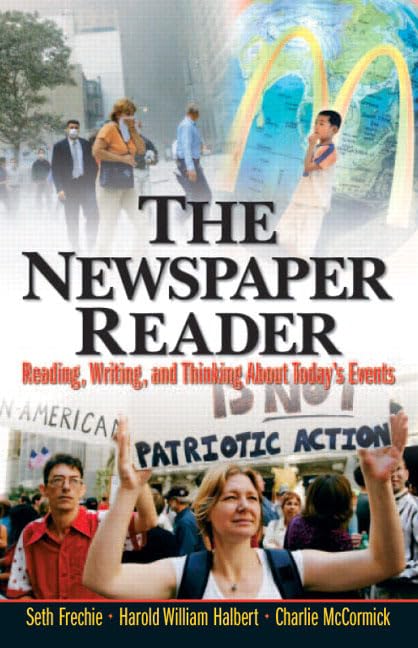
This book allows readers to bring newspapers into their everyday lives by promoting the idea that newspapers give us the opportunity to perceive ourselves as intrinsically involved in local, national, and global discussions. The only book of its kind on the market today, it provides a base for the development of critical thinking, reading, and writing skills as it shows ways in which we can reference newspaper articles as we work through new ideas and problems we encounter. This reader contains timely and interesting selections, and its organization mirrors that of any typical newspaper. Selections are divided into a News section, a Business section, a Discovery section, a Sports section, and a Life section. Each storyline presented includes a sample of an editorial, a report, and a feature article. Storylines include: the Jessica Smart case; the USA Patriot Act; Jayson Blair and The New York Times ; Amazon.com; lotteries; fast food; the Space Shuttle disaster; cyberspace; cloning; Michael Jordan; Nancy Kerrigan and Tonya Harding; The US Olympic Hockey Team and the Gold Medal; fashion and fads; diet; and the 9/11 attacks. An excellent and exciting book that provides an excellent tutorial on how to read a newspaper for maximum effect and benefit. Will provide special insight for ESL students and others learning about newspapers and article-writing. "It is probably the most innovative idea I have been exposed to in a long time! Highly recommended." Karen Hackley, Houston Community College "Organizing this reader in the pattern of a newspaper is an excellent and refreshing strategy .... For those who already read the newspaper with some regularity, it will be a familiar theme; for those unaccustomed to reading newspapers, this book may well open the door to a new and obvious tool to begin their journey into the world of current events .... Bravo to the authors for keeping the students' interests in mind throughout!" Julie Segedy, Chabot College From the Preface: The Newspaper Reader attempts to narrow the distance between the texts we use to teach critical reading, writing, and thinking and the lives of our students . . . . Newspapers are precisely abouteven as they are about more than-our students' experiences . . . . The Newspaper Reader, therefore, assumes that as students begin to love the process of reading in, writing on, and thinking about newspapers, their lives will become richer and more meaningful. Each section contains three storylines, and within each storyline is a single example of a report, an editorial, and a feature article. Therefore, each section contains nine reading selections: three reports, three editorials, and three feature articles. Including editorials, reports, and feature articles in each section reflects the fact that most developing writers concentrate on three types of essay: the personal experience essay, the expository essay, and the argumentative essay. The selections included in each section approximate these writing genres. There is a common refrainposed as a questionheard within educational circles: how do students learn to become lifelong readers, writers, and thinkers? The question seems logical enough to those of us who have chosen academic careers. We find joy in the discovery of reading, pleasure in the articulation of thoughts and ideas into textual and oral forms, and exhilaration in encountering ideas that challenge our own. We want our students to find this joy, pleasure, and exhilaration too. For most of our students, though, coming of age as they are in the early twenty-first century, the question seems almost silly. After all, they know that they are being asked to deal with an ever-increasing body of information and data in an increasingly quick manner. Who has the time to read, write, and think? As educators, our response tends to be "Who doesn't have the time to read, write, and think?" Yet however logical the response is, it lacks a certain sort of practical appeal. The better approach is not to preach to our students about what they should do but to show them how understanding ideas, modes of communication, and texts will make their life richerin every sense of the word. There is nothing radical to this approach. It has been the approach favored by generations of scholar/teachers. In practice, though, educators tend to show students the value of ideas, modes of communication, and texts through the "great texts": through authors such as Shakespeare, Weber, and Darwin among many, many deserving others. Important and necessary as these texts are, they seem distant from the lives and concerns of most of our students, especially those in the developmental stage of critical reading, writing, and thinking. The Newspaper Reader attempts to narrow the distance between the texts we use to teach critical reading, writing, and thinking and the lives of our students, not because we assume that students should stop with newspapers but,
More Information
| Gtin | 09780131836495 |
| Age_group | ADULT |
| Condition | NEW |
| Gender | UNISEX |
| Product_category | Gl_book |
| Google_product_category | Media > Books |
| Product_type | Books > Subjects > Reference > Writing, Research & Publishing Guides > Writing |