
Description
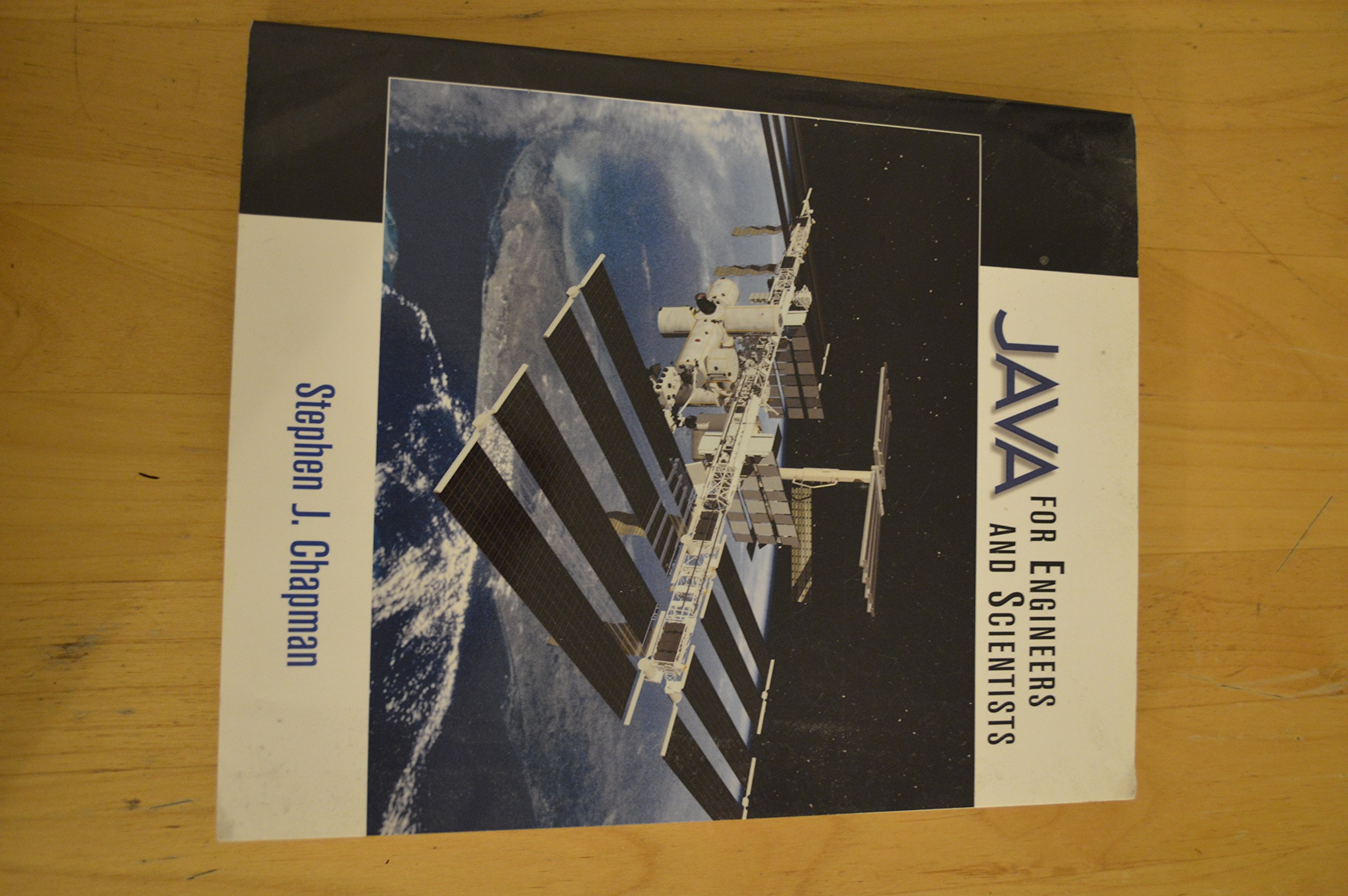
Develops and implements practical examples that demonstrate solving problems with Java in an engineering/science environment. Exemplifies software development practices. Softcover. DLC: Java (Computer program language) Aimed at the engineering student or scientifically inclined reader, Stephen Chapman's Java for Engineers and Scientists provides a remarkably useful and thorough introduction to Java for anyone who isn't afraid of math. One of the best things about this textbook-style guide is probably its many example problems and exercises drawn from engineering, mathematics, physics, and statistics. The author uses simple examples (and algorithms) to illustrate basic Java programming techniques, all told in a patient, thorough, and extremely comprehensible teaching style. To simplify things, the author includes his own custom classes at certain points for getting you over some missing or hard-to-code features of Java. (These classes include simple I/O classes, graphics classes for plotting data, and a complex number class.) The book certainly does not try to cover every Java feature, but it does cover the Java core API very well, along with Swing GUI basics. This book excels at mathematical processing in Java, with clear explanations of numeric data types, arrays, and complex numbers. It also is very careful to suggest good programming practice from basic design techniques and hints for creating maintainable code (such as correct naming and documentation). There is certainly no shortage of introductory texts for Java. Java for Engineers and Scientists distinguishes itself with not only a lucid style of presentation that perhaps belies its title, but also with its thorough range of examples, most of which will be accessible to anyone with a grasp of high school math or physics. For engineering students or for self-study for those with just a little math knowledge, this title turns out to be one of the best available guides to learning Java. --Richard Dragan Topics covered : Java fundamentals, naming, variables and data types, assignment and mathematical methods, top-down program design, flow control, arrays, graphics and plotting, object-oriented programming basics, inheritance and polymorphism, exceptions, complex numbers, strings, graphics, Swing basics, and file I/O. From the beginning, this book carefully develops and implements practical examples that demonstrate solving problems with Java in an engineering/science environment. This introductory text exemplifies excellent software development practices. Chapman uses a top-down design technique to show the reader how to create logical program modules. The author demonstrates object re-usability by building later examples on the classes and methods created in earlier examples. Finally, the approach emphasizes how to write reliable Java programs. This book makes learning an interactive experience by providing all sources for all examples through a Website. Leads students or professionals into problem solving without unnecessary Java language details - Provides Java class libraries emphasizing the re-usable nature of objects derived from Java classes - Provides a set a flexible graphics classes, allowing students to easily display and print graphical data in their programs - Provides classes of practical use to Engineers and Scientists, such as classes to format numbers for display, to perform array-based operations, and to perform useful algorithms such as FFTs, correlation, and convolution - Includes supplemental material in hard copy and on-line sources STEPHEN J. CHAPMAN is an Electrical Engineer with a specialty in Digital Signal Processing and Radar Systems. His career has included more than 20 years of experience writing large programs in Defense and Seismic Signal Processing environments. His projects have included real-time radar programming for M.I.T.'s Lincoln Laboratory; developing seismic signal processing algorithms for Shell Oil Company and large simulation programs for British Aerospace Australia. He has taught Electrical Engineering and Electrical Technology Programs at the University of Houston and Computer Science in the Pacific Division of the University of Maryland. STEPHEN J. CHAPMAN is an experienced author with several books already to his credit, including his first book with Prentice Hall, an E-Source title, Introduction to Java. Preface The basic purpose of this book is to simultaneously teach the Java programming language, structured programming techniques, and good programming practice to an audience of science and engineering students. Java is a relatively new programming language, but it is taking the world by storm. The language has enormous appeal for many reasons. One major reason is that it is largely platform independent, meaning that an application written for one computer is very likely to run unchanged on another computer. Thus, a single application can be written to execute across all of a compa
More Information
| Gtin | 09780139195235 |
| Age_group | ADULT |
| Condition | NEW |
| Gender | UNISEX |
| Product_category | Gl_book |
| Google_product_category | Media > Books |
| Product_type | Books > Subjects > Computers & Technology > Software |