
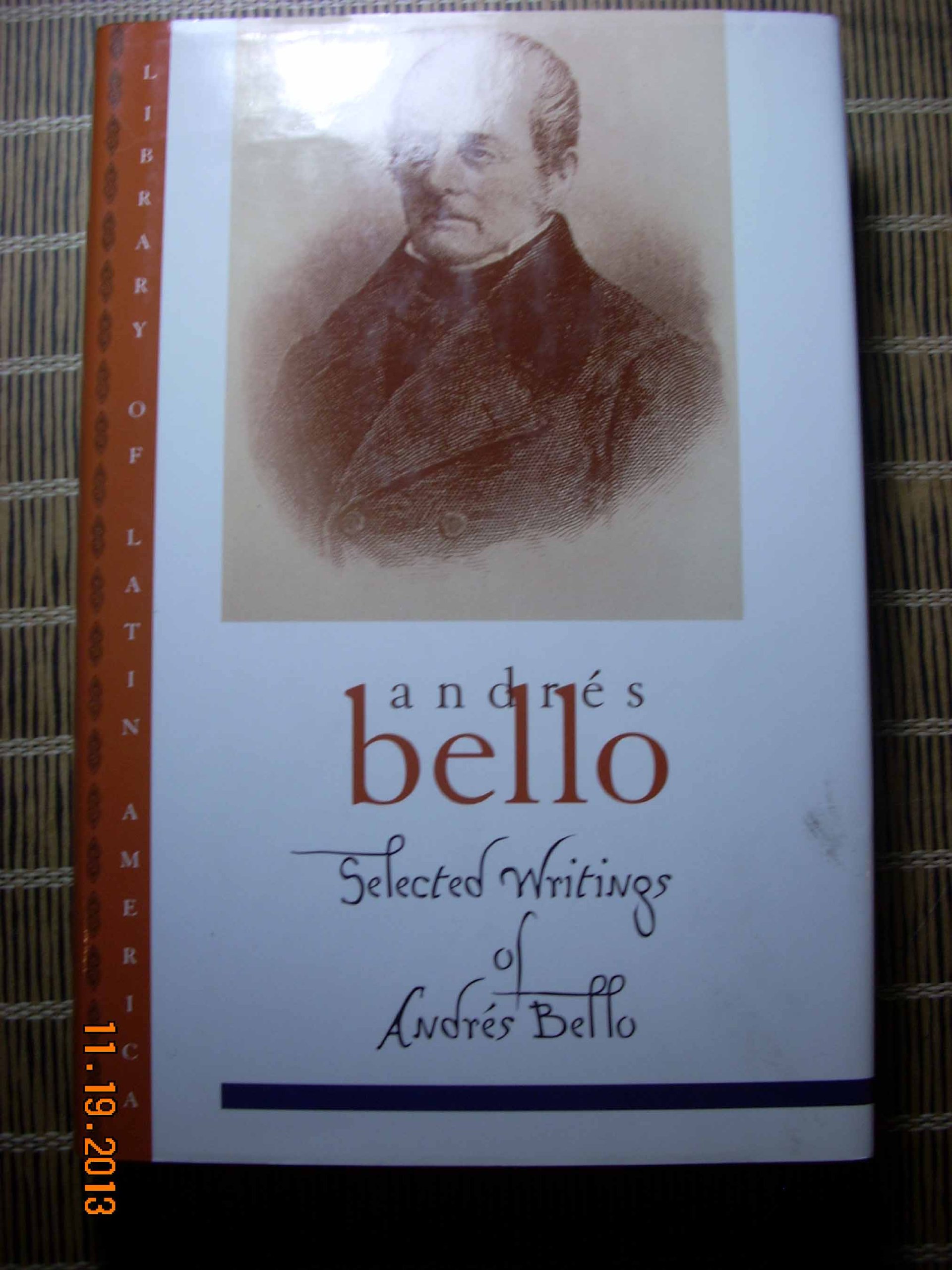
Description
Andres Bello was a towering figure in nineteenth-century Latin America. Poet, politician, educator, essayist, philosopher, he encompassed an enormous spectrum of concerns, wielded astonishing influence, and played a major role in shaping the national identities of newly independent Latin American countries. Indeed, in North America perhaps only Thomas Jefferson presents a figure of comparable scope and stature, and Bello is as crucial and as famous in Latin America as Jefferson is in the United States. Nearly every city in Latin America has its Andres Bello Avenue, its Andres Bello statue, even its Andres Bello university. He held several key government positions, authored Chile's civil code, launched several newspapers, wrote prodigiously on a vast array of subjects, and implemented important educational reforms. Yet until now his work has remained virtually unknown to English-speaking readers. The Selected Writings of Andres Bello , edited by Ivan Jaksic, brilliantly succeeds both in representing the full range of Bello's contribution and in giving us a coherent picture of his thought. The selections gathered here explore such subjects as grammar and philology, constitutional reform, the aims of education, international relations, historiography, Latin and Roman Law, government and society, and many others. Throughout his work, Bello's central concerns with language, education, law, and the nature of responsible government and responsible citizenship, appear again and again. In one essay, Bello traces the evolution of writing from the earliest pictorial symbols to the development of an alphabet capable of communicating abstract ideas. In another, he argues that representative government, more than any other, depends upon a literate and educated citizenry. And in another, he asserts that freedom requires laws that are equally observed by everyone. "Can there be greater injustice," he asks, "than a readiness to trample on the rights of others, while trying to have one's own rights religiously observed?" In these and many other essays, Bello writes with grace, extraordinary insight, and a clear-headed vision of what would be necessary to provide a sustainable order for the fledgling republics of Latin America. More than any of his contemporaries, Bello provides the crucial bridge between the cast-off colonial culture of the Spanish empire and the promising beginnings of the new nation-states. As part of the Library of Latin America series, The Selected Writings of Andres Bello gives us a generous sampling of a gifted and graceful thinker who must be included in any understanding of the origins and development of Latin America. Available in English for the first time, the greatest essays and speeches of the 19th-century Latin American educator, politician, and scholar, a leading figure in building a humanistic post-colonial tradition in Latin America. The pieces included here cover a range of subjects, from public education to historiography to language studies. Bello (17811865), who was born in Venezuela, spent many years abroad. While living in Europe, Bello launched several journals intended for a Latin American audience, focusing on the means of constructing the region's new nations. His goal, presented in the prospectus included here, was to aid Latin America in ``completing its process of civilization,'' a task he pursued for the next 40 years, especially after returning to Latin America. His epic poem ``Allocution to Poetry'' praises the continent's natural beauty and stimulated others to pursue a distinctly Latin American tradition in letters. His essay on Spanish grammar rejects the dependence on Latin in the pedagogy of the day and stresses the application of logic to teaching, understanding, and applying grammatical rules. Writing as the rector of the Colegio de Santiago, and later as the first rector of the University of Chile, Bello stresses the importance of public education in the construction of a working democracy, and argues that morality (``inseparable from religion'') must be a key theme in education. As a member of the Chilean Congress, Bello drafted the nation's civil code, which attempts to clarify issues surrounding property and contracts in the context of a new civil society. Bello, a reveler in archives, passionately argues that history is at its core ``the science of humanity,'' yet another way of supplying nations with vital ideas. As a teacher he provided an apt example of what academic disciplines could contribute to society. And as a writer and thinker he did a good deal to wean Latin America off its stance of intellectual servility to the Old World. -- Copyright ©1997, Kirkus Associates, LP. All rights reserved. "Available in English for the first time, the greatest essays and speeches of the 19th-century Latin American educator, politician, and scholar, a leading figure in building a humanistic post-colonial tradition in Latin America."--Kirkus Reviews"Andres Bello stands
More Information
| Gtin | 09780195105452 |
| Age_group | ADULT |
| Condition | NEW |
| Gender | UNISEX |
| Product_category | Gl_book |
| Google_product_category | Media > Books |
| Product_type | Books > Subjects > Literature & Fiction > History & Criticism > Regional & Cultural > Caribbean & Latin American |