
Description
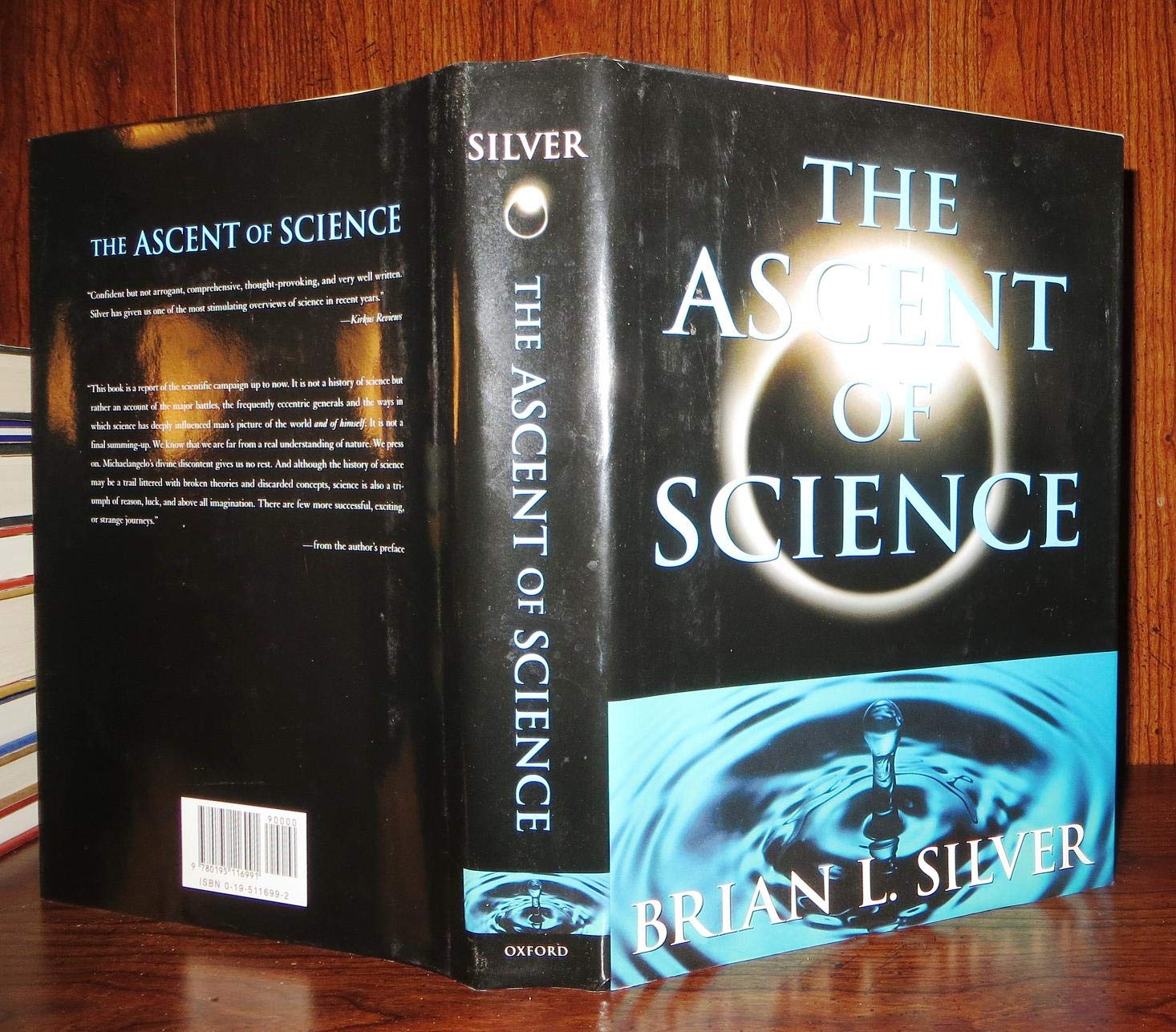
From the revolutionary discoveries of Galileo and Newton to the mind-bending theories of Einstein and Heisenberg, from plate tectonics to particle physics, from the origin of life to universal entropy, and from biology to cosmology, here is a sweeping, readable, and dynamic account of the whole of Western science. In the readable manner and method of Stephen Jay Gould and Carl Sagan, the late Brian L. Silver translates our most important, and often most obscure, scientific developments into a vernacular that is not only accessible and illuminating but also enjoyable. Silver makes his comprehensive case with much clarity and insight; he locates science as the apex of human reason, and reason as our best path to the truth. For all readers curious about--and especially those perhaps intimidated by--what Silver calls "the scientific campaign up to now" in his Preface, The Ascent of Science will be fresh, vivid, and fascinating reading. The Ascent of Science is a remarkable achievement: a concise, informative, and easily readable book that breathes life into an often dry, impenetrable subject. The lengthy text spans several centuries of scientific discovery and theory, from the Renaissance to the nineties--it even looks to the future. This is also a who's who of major scientific players throughout history: Voltaire, Newton, Bacon, and Einstein, among others. But don't be put off by the prospect of information overload--author Brian Silver remains succinct and engaging throughout, and even highly complex areas such as relativity and chaos are made accessible by Silver's wit and energy. This is more than a primer on science; Silver contextualizes science within the philosophy and politics of past and present times. Of particular fascination is the Renaissance era, when scientific reasoning was equated with a violation against God. Descartes was accused of fostering atheism, because of his belief that God's role was as creator of the universe only, and not as "mover of the planets." (Descartes's books were banned by the Catholic church in 1663.) Although Silver died prior to the publication of The Ascent of Science , his book remains a lasting testament to his love for science and his remarkable ability to open up this world to everyone. The author of this massive work has two objectives: to explain the major scientific developments from earliest time through today in nontechnical terms and to set science in its social perspective?including its effects on the relationship of humanity to society, our self-image, and our ideas of God. Silver (physical chemistry, Israel Inst. of Technology) has succeeded in both areas, although his history of science and technical explanations seem to be more coherently organized and presented. His analogies to explain difficult or esoteric scientific areas often make his explanations remarkably clear, for example, his explanation of the mechanics of "doping" semi-conductors. Silver's opinions and sense of humor are evident throughout the book, and the footnotes contain a substantial share of personal references and interpretations. The breadth of Silver's coverage of the philosophers of science as well as the historians is also impressive. Recommended for all libraries.?Hilary Burton, Lawrence Livermore National Lab., Livermore, Cal. Copyright 1998 Reed Business Information, Inc. This pleasing volume undertakes--with considerable success- -to chart the broad history of science from the Renaissance to the end of the 20th century. Silver (Physical Chemistry/Israel Institute of Technology), focuses on the evolution of scientific theories rather than science's practical benefits. At the same time, he emphasizes that, more than ever, ``science has to be watched,'' because its impact on the world at large is too important to be left entirely to specialists. Silver therefore aims his book squarely at the common reader. His description of the nature and general behavior of gas molecules draws on such familiar experiences as a harried passenger attempting to cross a crowded railway station. A chapter on the nature of scientific evidence contrasts Descartes's radical skepticism with Bacon's trust in the evidence of his senses, building up to an attempt to answer those whose skepticism regarding science grows out of religious conviction. The history proper begins with Newton and Galileo, who between them laid out the broad outlines of scientific rationalism. The romantic reaction to science at the end of the 18th century was fueled in part by the discovery of phenomena that Newton's laws could not account for: notably electricity, research into which led the way to many of the discoveries of 19th-century science. At the same time, progress in the other sciences (especially biology) brought equally profound alterations not only in our understanding of the world, but in our ability to manipulate it. Silver's explanations of the leading theories and discoveries- -including their philosophical
More Information
| Gtin | 09780195116991 |
| Age_group | ADULT |
| Condition | NEW |
| Gender | UNISEX |
| Product_category | Gl_book |
| Google_product_category | Media > Books |
| Product_type | Books > Subjects > Science & Math > History & Philosophy |