
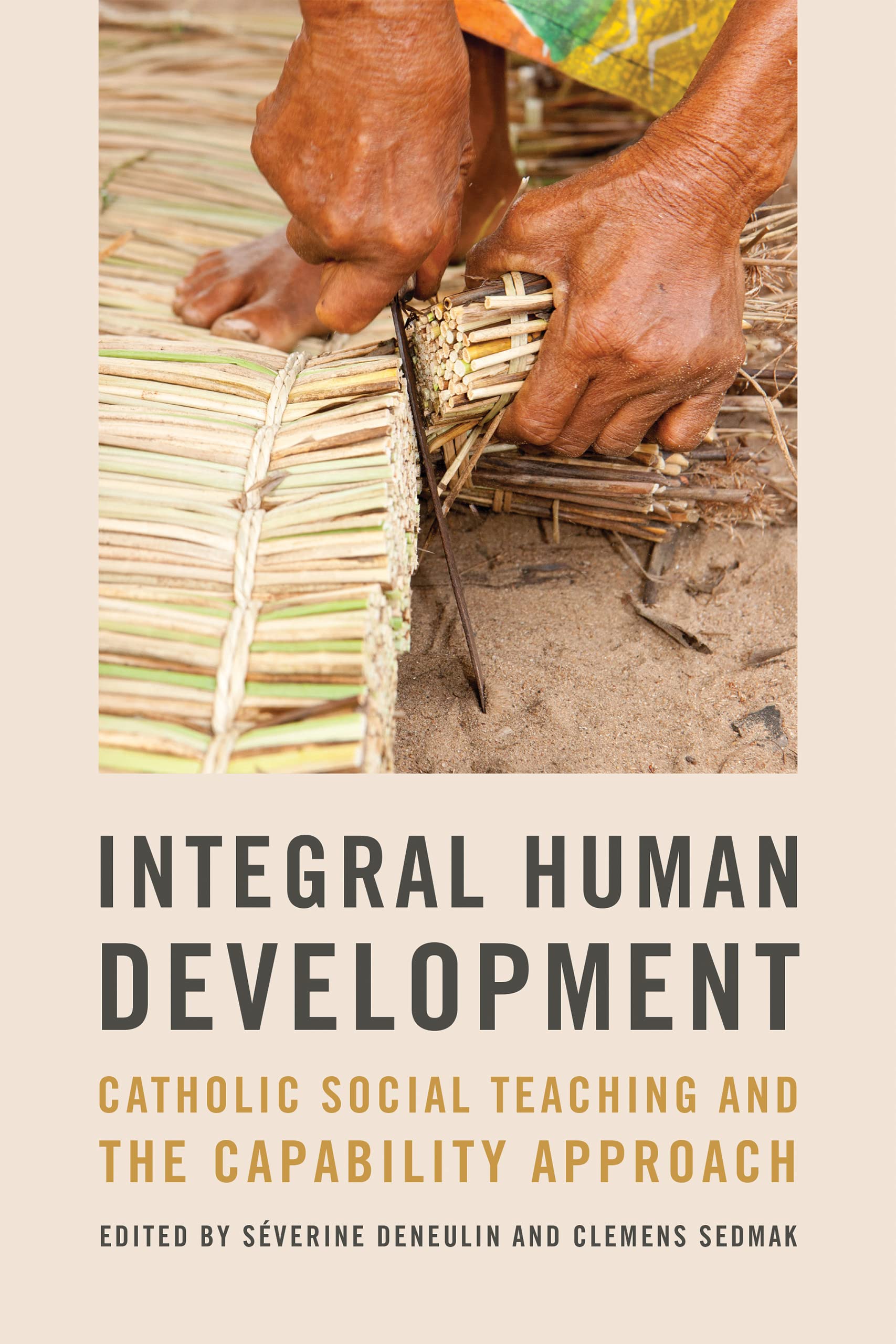
Integral Human Development: Catholic Social Teaching and the Capability Approach (Kellogg Institute Series on Democracy and Development)($54.54Value)
$54.54
Integral Human Development: Catholic Social Teaching and the Capability Approach (Kellogg Institute Series on Democracy and Development)($54.54Value)
Description
This volume brings into conversation two major moral traditions in the social sciences and humanities that offer common areas for understanding, interpreting, and transforming the world. Over the last decade, moral theologians who work on issues of poverty, social justice, human rights, and political institutions have been finding inspiration in the capability approach (CA). Conversely, social scientists who have been working on issues of poverty and social justice from a CA perspective have been finding elements in the Catholic social tradition (CST) to overcome some of the limitations of the CA, such as its vagueness regarding what counts as a valuable human life and its strong individual focus. Integral Human Development brings together for the first time social scientists and theologians in dialogue over their respective uses of CST and CA. The contributors discuss what their mutual grounds are, where they diverge, and where common areas of collaboration and transformative action can be found. The contributors offer a critical analysis of CA from the perspective of theology. They also provide an original account of CST. The book offers a broader historical, biblical, social, economic, political, and ecological understanding of CST than that which is currently available in the CST literature. The book will interest students and practitioners in global affairs, development studies, or the social sciences who seek to better understand the Catholic tradition and its social teachings and what they can offer to address current socio-environmental challenges. Contributors: Séverine Deneulin, Clemens Sedmak, Amy Daughton, Dana Bates, Lori Keleher, Joshua Schulz, Katie Dunne, Cathriona Russell, Meghan J. Clark, Ilaria Schnyder von Wartensee, Elizabeth Hlabse, Guillermo Otano Jiménez, James P. Bailey, Helmut P. Gaisbauer, and Augusto Zampini-Davies. “The wide range of authors and the variety of approaches, from analysis of literature and critique of limitations of one or another position, to reports on actual development work in different parts of the world, make it a rich compendium contributing to an important conversation between Catholic social teaching and the capability approach.” ―Patrick Riordan, S.J., author of Recovering Common Goods "This is a book to borrow and relish. ...It wrestles thoughtfully with an issue that should concern us all in a pluralistic world that faces very serious, human-induced, global challenges." ― Church Times Séverine Deneulin is the director of international development at the Laudato Si’ Research Institute, Campion Hall, University of Oxford, and an associate fellow at the Oxford Department of International Development. She is the author of Human Development and the Catholic Social Tradition: Towards an Integral Ecology . Clemens Sedmak is professor of social ethics at the University of Notre Dame and author of The Capacity to Be Displaced . A CALL TO DIALOGUE AND ACTION ( from *Introduction , pp. 4-7*) All the above initiatives and searches for new understanding can be seen as “signs of the times,” an expression that has become part of Catholic tradition since the Second Vatican Council. Well before the UNDP launched its Human Development Reports in 1990 and argued that the question of development and progress is linked to the question of what it is to be human, the Catholic tradition had been reflecting on these questions for a long time. As an intellectual tradition that seeks to analyze social and economic realities from the perspective of the Christian faith, the social teachings of the Catholic tradition, known as Catholic Social Teaching (CST hereafter), have long been exploring questions of socio-economic development and its ultimate ends, an idea we will develop further shortly. CST offers an interpretative framework, a normative vision for personal and social transformation. The normative vision of CST is rooted in a moral tradition that recognizes “constants in context” (Bevans and Schroeder 2004), universal aspects of the human condition with tangible normative impacts. This tradition is linked to the idea of natural law (Pope 2005) and has been criticized, among other reasons, on the grounds of a suspected fact/value fallacy and an explicit “essentialism” (Pope 2001, 90–92). These criticisms may not share the theoretical assumptions of the tradition and its commitment to moral realism and universalism, but might nonetheless support important aspects of the “practical force of natural law” expressed in the Nuremberg trials, the Universal Declaration of Human Rights, or Martin Luther King, Jr.’s “A Letter from a Birmingham Jail” (Pope 2001, 92). The situation we find ourselves in may justify a focus on the practical implications of this normative universal vision rather than the theoretical disagreements. Different approaches may be able to find the concepts of human dignity or integral human development useful, even without a consensus on justificatio
More Information
| Gtin | 09780268205706 |
| Age_group | ADULT |
| Condition | NEW |
| Gender | UNISEX |
| Product_category | Gl_book |
| Google_product_category | Media > Books |
| Product_type | Books > Subjects > Religion & Spirituality > Christian Books & Bibles > Theology > Ethics & Moral Teaching |