
Description
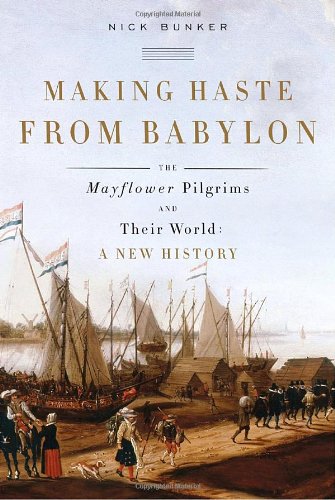
At the end of 1618, a blazing green star soared across the night sky over the northern hemisphere. From the Philippines to the Arctic, the comet became a sensation and a symbol, a warning of doom or a promise of salvation. Two years later, as the Pilgrims prepared to sail across the Atlantic on board the Mayflower , the atmosphere remained charged with fear and expectation. Men and women readied themselves for war, pestilence, or divine retribution. Against this background, and amid deep economic depression, the Pilgrims conceived their enterprise of exile. Within a decade, despite crisis and catastrophe, they built a thriving settlement at New Plymouth, based on beaver fur, corn, and cattle. In doing so, they laid the foundations for Massachusetts, New England, and a new nation. Using a wealth of new evidence from landscape, archaeology, and hundreds of overlooked or neglected documents, Nick Bunker gives a vivid and strikingly original account of the Mayflower project and the first decade of the Plymouth Colony. From mercantile London and the rural England of Queen Elizabeth I and King James I to the mountains and rivers of Maine, he weaves a rich narrative that combines religion, politics, money, science, and the sea. The Pilgrims were entrepreneurs as well as evangelicals, political radicals as well as Christian idealists. Making Haste from Babylon tells their story in unrivaled depth, from their roots in religious conflict and village strife at home to their final creation of a permanent foothold in America. A Q&A with Author Nick Bunker Question: What made you, as an Englishman, want to tell the story of the Mayflower Pilgrims? Nick Bunker: Before they were American, they were English, and a revolutionary war had to be fought before the two nations separated for good. Long after the Mayflower , the history of England and America remained deeply intertwined. You can’t understand one without delving into the other as well. In my case there’s also a family reason for my fascination with the American past. I’m called Bunker. For centuries the Bunkers lived lives of total obscurity, as farmhands and farriers and the like in the countryside northwest of London. Except for one Bunker, a yeoman farmer called George, born in about 1600. It seems that George Bunker became a Puritan and in 1632, he sailed to Massachusetts, most likely on the Lyon, a ship which also supplied the Plymouth Colony. He settled at Charlestown, where he gave his name to Bunker Hill, but George was a free-thinking man who upset the authorities by supporting the religious radical Anne Hutchinson. So they took away his gun, and banned him from holding public office. Even so, he did well. George Bunker became one of the earliest benefactors of Harvard College. His descendants were still living at Charlestown in 1775, when Bunker Hill became a battlefield. You won’t find George Bunker in Making Haste from Babylon , but his story wasn’t so very different from those of the Pilgrims on the Mayflower . It raises the same kind of questions. Exactly why did they embark on this bold, hazardous project called New England? What did they find when they arrived? How and why did they succeed, so that families like the Bunkers, who’d been unknowns in England, came to be entrepreneurs in America, the kind of people you read about in Moby Dick ? I find these questions fascinating, but very few Britons have shown any interest in answering them. That’s why I decided to write the book. I felt that it was time the story was told from an English perspective, and I guessed that historians had overlooked a mass of relevant material here in the United Kingdom. Question: You unearthed an extraordinary number of documents relating to the Pilgrims and the early settlement of New England, most of them virtually untouched. How did you find these records? And what do they reveal? Nick Bunker: It’s a matter of timing. In the 19th century, when people started to look to the Pilgrim Fathers and the Mayflower as the inventors of America, scholars from New England began to make visits to London in search of archive material that might shed more light upon them. By the time of the tercentenary in 1920, it looked as though every relevant document had been discovered. Since then, many books have appeared about the Plymouth Colony, both academic and popular. But with only one or two exceptions the authors have relied entirely upon sources which were already in print a century ago. Since 1945, record offices in England have made available huge quantities of new material from the Tudor and Stuart period, documents which were previously either hidden away in private hands, unlisted, or too badly damaged for use by scholars. Archivists have sorted out and numbered thousands of loose papers, created new catalogues, undertaken conservation projects, and become far more open and accessible. Of course, only a tiny fraction of their holdings relate to people
More Information
| Gtin | 9780307266828 |
| Mpn | New18-03-012016-b0170899 |
| Age_group | ADULT |
| Condition | NEW |
| Gender | UNISEX |
| Product_category | Gl_book |
| Google_product_category | Media > Books |
| Product_type | Books > Subjects > History > Americas > United States > Colonial Period |