
Description
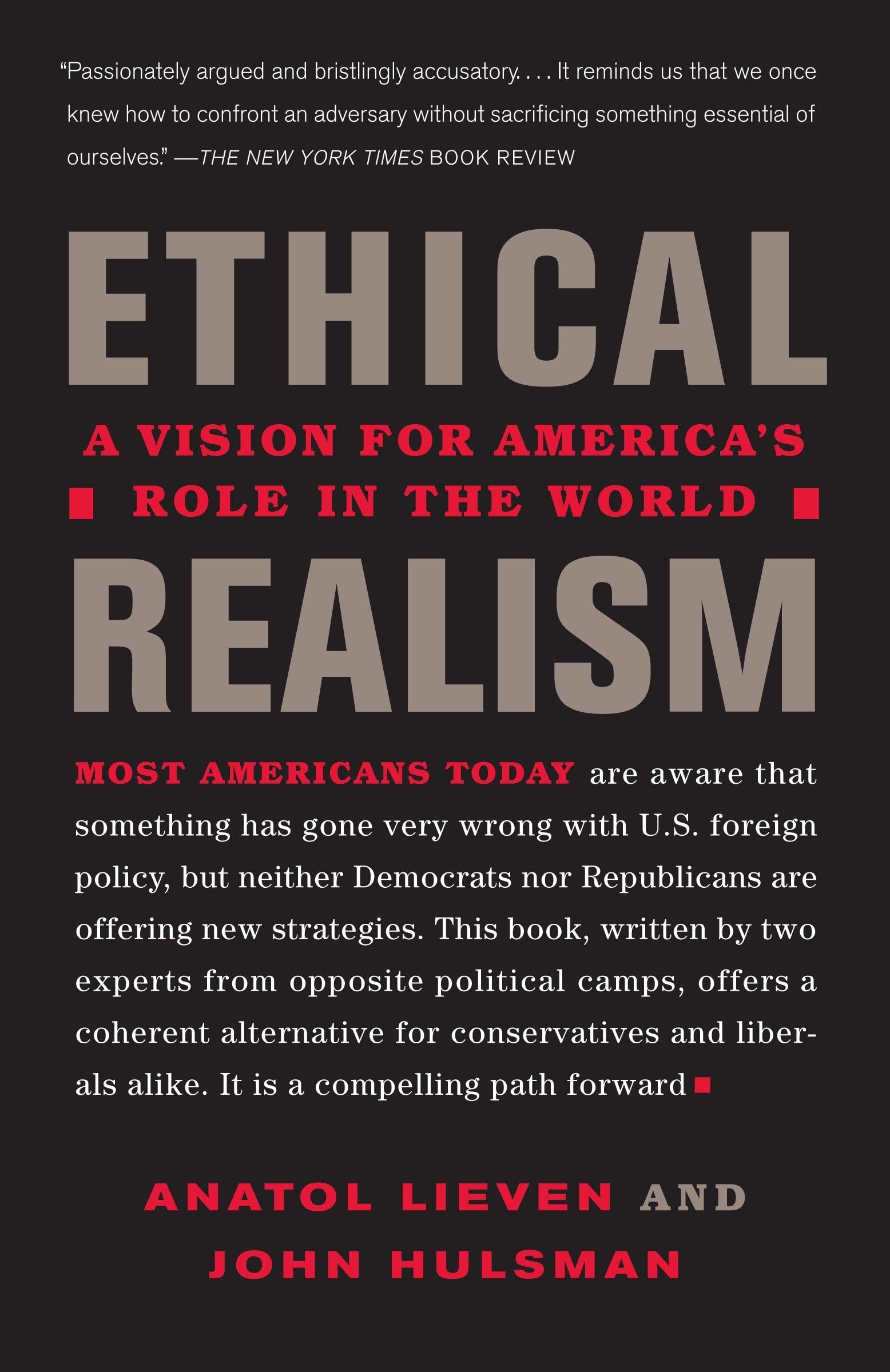
America today faces a world more complicated than ever before, but our politicians have failed to envision a foreign policy that addresses our greatest threats. Ethical Realism shows how the United States can successfully combine genuine morality with tough and practical common sense. By outlining core principles and a set of concrete proposals for tackling the terrorist threat and contend with Iran, Russia, the Middle East, and China, Anatol Lieven and John Hulsman show us how to strengthen our security, pursue our national interests, and restore American leadership in the world. “Passionately argued and bristlingly accusatory. It reminds us that we once knew how to confront an adversary without sacrificing something essential of ourselves.”— The New York Times “Lieven and Hulsman are passionate in their sobriety and remarkably concrete about the steps to be taken.” — The Atlantic Monthly “Makes a powerful case that the United States needs a foreign policy based on hard facts and what we can achieve with our available resources, in order not to retreat from a U.S. world role, but, on the contrary, ‘to live up to its glorious national promise.’ ” —General Brent Scowcroft, former national security adviser“A profoundly necessary alternative to the arrogance of preemptive warfare. . . . Ethical Realism is characterized by prudence, humility, understanding, responsibility, and genuine patriotism, and is deeply rooted in the best of America’s history.” —Senator Gary Hart Anatol Lieven is a senior research fellow at the New America Foundation and is the author of America Right or Wrong: An Anatomy of American Nationalism . He writes regularly for the Financial Times and the International Herald Tribune , among other publications. He lives in Washington, D.C. John Hulsman is a former senior research fellow at The Heritage Foundation and a member of the Council on Foreign Relations, as well as a contributing editor to The National Interest . He advises congressional leaders from both parties on foreign policy issues and makes regular appearances on ABC, CBS, Fox News, CNN, MSNBC, PBS, and the BBC. He lives in Culpeper, Virginia. OneLessons of the Truman-Eisenhower MomentThe best test of truth is the power of the thought to get itself accepted in the competition of the market.–oliver wendell holmesWith the passing of George Kennan in March 2005, the last living member of the Truman administration, the most successful foreign policy team in modern American history, left the stage. Between 1945 and 1960, these men and their successors and de facto allies in the Eisenhower administration set the United States on the road to eventual victory in the Cold War. The success of the containment doctrine that they developed can be gauged by the fact that it was followed in one form or another until the collapse of the Soviet Union.The triumph of the Truman years is all the more remarkable given that at the time of his swearing in, Harry Truman’s only trip overseas had been as an artillery officer in World War I; he had never spoken to a Soviet citizen. What he did possess was native shrewdness; tremendous strength of character; deep patriotism and sense of responsibility; and not least, the self-confidence to appoint brilliant men to positions of responsibility and then back them to the hilt. For in the wake of World War II, with a new threat, Soviet Communism, facing the West, Truman and his team, somewhat unexpectedly followed by Eisenhower, established an entirely new model for American foreign policy that led to victory against an entirely different sort of enemy.The threat of Soviet Communist expansionism after 1945 was not a sudden shock like Pearl Harbor or 9/11, but it was just as much of a jolt to the American system and attitudes. For the first time, the United States was faced with the need for permanent mobilization to meet a severe and open-ended global threat and maintain an indefinite and massive set of global commitments.Until the Cold War, America’s military commitments beyond its shores had always been brief, and with a predictable end. Most were short wars, after which it was assumed that America would go home; in the case of the occupations of the Philippines and several Caribbean nations after the defeat of Spain, the overseas commitments were small-scale. None of them required the United States to create a permanent conscript army or permanent security institutions like those the European states had had to develop over the centuries. Indeed, much of America’s political tradition, since the first days of the colonies, was founded precisely on hostility to such “standing armies.”Not only did the Cold War now require such massive permanent mobilization, but the existence of atomic bombs made a general war with a relatively quick victory with limited losses–as in previous wars–difficult to imagine. After the United States and the Soviet Union both developed thermonuclear weapons, easy victory was al
More Information
| Color | Black |
| Gtin | 09780307277381 |
| Mpn | 0307277380_used |
| Age_group | ADULT |
| Condition | NEW |
| Gender | UNISEX |
| Product_category | Gl_book |
| Google_product_category | Media > Books |
| Product_type | Books > Subjects > Politics & Social Sciences > Politics & Government > Specific Topics > War & Peace |