
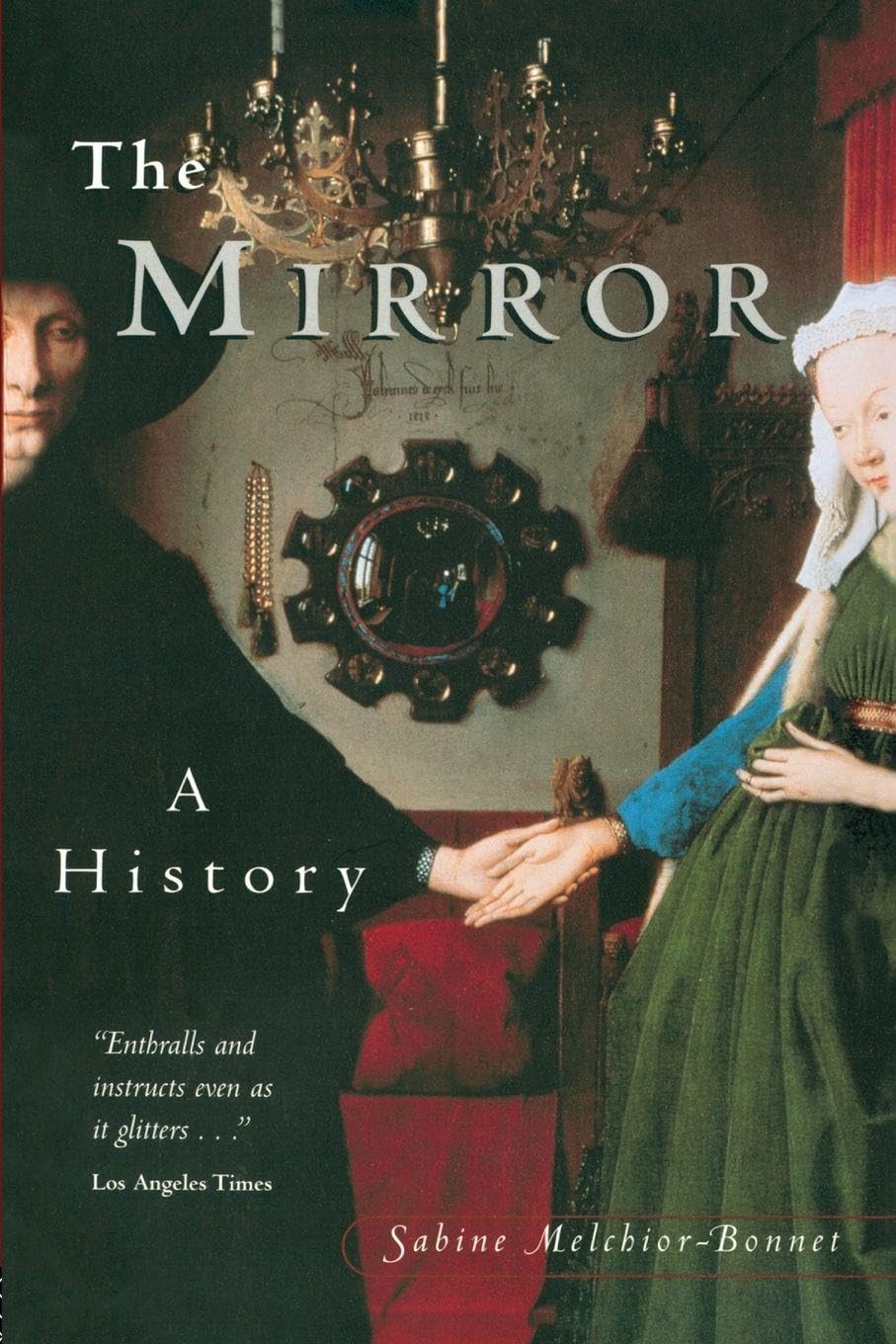
Description
This engaging and witty cultural history traces the evolution of the mirror from antiquity to the present day, illustrating its journey from wondrous object to ordinary trinket. With its earliest invention, the mirror allowed us to gaze upon ourselves, bestowing a power both fascinating and terrifying. "An engagingly written work, well worth reading." -- Choice " The Mirror is an amusing jewel of a book, a sparkling reflection of the history of the mirror in Europe, and the role of the mirror in European imagination." -- Los Angeles Times "Presents such facts with erudite relish. The early chapters of The Mirror are a feast of technological information and curious details of European social history." -- The Wall Street Journal "Sabine Melchior-Bonnet has taken the reflective piece of glass and turned it into a unique historical treatise on -- when you boil it down -- why human beings like to look at themselves and what that instinct means." -- Chicago Tribune "Melchior-Bonnet's research-rigorous and vast-reveals much about our most carnal selves, our lust for control over our image, and our most lofty spiritual aspirations." -- The National Post Sabine Melchior-Bonnet is an instructor at the College de France in Paris. This is her first work to be published in English. The Mirror A History By Sabine Melchior-Bonnet Routledge Copyright © 2002 Sabine Melchior-Bonnet All right reserved. ISBN: 0415924480 Chapter One The S ecret of Venice Metal Mirrors and Glass Mirrors The First Mirrors Even though the mirror was for centuries a rare object endowedwith magical and often disturbing powers, it would be wrong tospeak of a pre-mirror and a post-mirror schism. Man has beeninterested in his own image since prehistoric times, using allsorts of expedients?from dark and shiny stones to pools of water?inorder to catch his reflection. The myths of Narcissus,who is enchanted by his own image, and Perseus, who makesMedusa see herself in his shield, bear witness to this early curiositytoward reflecting surfaces. Indeed, even in his ownshadow, man had already found his double. He had to wait centuries,however, before he could obtain a bright, clear, and trueimage of himself. The metaphorical distance from the polishedsurface of a small lead mirror to the great mirrors manufacturedby the Saint-Gobain Company is about the same as that betweenoilpaper panes and the glass display windows of departmentstores. The act of seeing oneself between two mirrors?whetherin profile or from behind?is, in proportion to the scaleof history, very recent. Ancient Mediterranean civilizations were obsessed withbeauty. Mycenea, Greece, Etruria, Rome and, before them,Egypt, made mirrors of metal, most often by mixing an alloy ofcopper and tin. Bronze was also used, but in very thin sheets tominimize rusting. Appropriately, the invention of the mirrorwas attributed to Hephaistos, the Greek god of fire and metal.Scenes of elegant Corinthians gazing at themselves in smalldisks of polished metal attached to handles or footstands andsometimes decorated on the back with mythological scenes canbe seen on antique pottery from the fifth century B.C. Morerefined mirrors were made of silver, or more rarely, of gold; silveringand gilding were applied with heat. Nearly alwaysrounded, these mirrors were either concave or convex, the formerenlarging the size of the reflected object, the latter reducingit. Ancient mirrors were generally very small?roughly five toeight inches in diameter?and were used primarily in threeways: as pocket mirrors enclosed in cases; as grooming mirrorsequipped with a welded handle and a ring so they could be heldbefore a master's face by his slave while he went about his dailygrooming and then hung on the wall; and finally, as stationarymirrors propped on a three-legged stand, which often depicted afeminine or masculine silhouette. Scrolls, palms, and crownsdecorated the metal or wood frames of the polished disk. Theirowners took great care of them and protected them from rust,stains, and scratches with fabric coverings, remnants of whichare still visible in the specimens that exist today. Mirrors similar to Greek ones with handles, footstands, andcases have been found in the tombs of Etruscan women. As forwealthy Roman women, their inability to deprive themselves ofsuch objects merited this reprimand by Seneca, "For a single oneof these mirrors of chiseled silver or gold, inlaid with gems,women are capable of spending an amount equal to the dowrythe State once offered to poor generals' daughters!" Romanslater invented new shapes, producing square or rectangular mirrors,perhaps borrowed from the Etruscans, with ivory handles.Fine sponges were attached to the frames and were used to cleanthe metal, which needed to be polished before each use. Eventuallyservants themselves acquired mirrors, and silver surpassedbronze as the preferred metal. Under the Roman Empire, mirrorswere also
More Information
| Color | Multicolor |
| Gtin | 09780415924481 |
| Mpn | 12 Line Drawings, 12 B&w Photographs |
| Age_group | ADULT |
| Condition | NEW |
| Gender | UNISEX |
| Product_category | Gl_book |
| Google_product_category | Media > Books |
| Product_type | Books > Subjects > Arts & Photography > History & Criticism > History |