
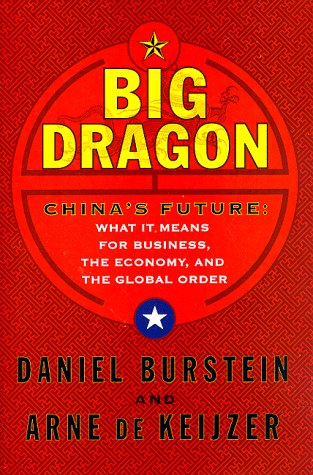
Description
A thought-provoking guide for business leaders and policy makers suggests that maintaining positive relations with China depends largely on an understanding of Chinese culture and anticipated political changes over the next twenty-five years. 35,000 first printing. Tour. China by the year 2030 will be not only the world's most populous nation, but also the world's largest economy, a superpower in every sense of the word. Its emergence as "the biggest player in the history of man," in the words of former Singapore prime minister Lee Kuan Yew, will shift the global balance of wealth and power in the next millennium. Big Dragon draws a nuanced portrait of the historic changes now underway in China and drafts a practical blueprint for maintaining constructive Sino-American relations. The book is must reading for anyone concerned with international business, finance, or politics. That should include almost everyone. Coauthors Daniel Burstein and Arne de Keijzer show a deep understanding of China's rich culture and manifold complexities as a society. Burstein is an investment banker who has written four other books on global economic issues, including Yen! , on the Japanese economy. Arne de Keijzer consults with companies doing business in China and is the author of three guides to the country, including China: Business Strategies for the '90s . The authors analyze both the challenges and the opportunities posed by China in the next century. Without airbrushing China's authoritarian government, geopolitical ambitions, or abysmal record on human rights, Big Dragon seeks to counter the views of some in the U.S. who conclude that China is the enemy. Burstein and de Keijzer believe China is unlikely to become militarily aggressive, though the status of Taiwan involves the potential for conflict. They believe China will not disintegrate like the Soviet Union, though regions will continue to struggle with Beijing for greater autonomy, perhaps bringing about a degree of federalism. Big Dragon profiles many individual Chinese entrepreneurs and others who are bringing a new China into being. From the transformations the Chinese have already wrought, the authors believe that China's journey down the path toward a pluralistic economy and even a form of democracy is irreversible. If so, the best policy for the U.S. and other powers is what the authors call "dynamic engagement" with China. They favor continued, normal trade as the only means to persuade China to do better on human rights and in other areas of conflict, such as intellectual piracy. They favor integrating China into the world economy through membership in the World Trade Organization and other international bodies. And they favor a broad expansion of U.S.-China exchange programs involving students, elected officials, and community leaders. Big Dragon is a useful antidote to the cartoon versions of China proffered in some books and in many Western news media. Burstein and de Keijzer communicate a sense of China's complex diversity. Like any nation--more so, because of its size--China is full of contradictions. Putting them in perspective and gaining a better sense of where they may lead will be hugely important in understanding the shape of the world to come. Big Dragon is an excellent guide. --Barry Mitzman Burstein has written several books dealing with global economics, two of them focusing on Japan. Given recent financial crises in Asia, Burstein may have to not only reassess yet again his forecasts regarding a Japanese resurgence but also reevaluate some of the bolder predictions made here in this new and impressively detailed book about China. Regardless, Burstein and China-watcher De Keijzer offer the first comprehensive appraisal of China since the death of Deng Yiaoping. The authors project that China will become the world's largest national economy sometime around 2030. They also suggest that its politico-economic system will be unlike any other and that it will include influences from both socialism and capitalism. Burstein and De Keijzer minimize any so-called Chinese threat and predict that the U.S. and China will coexist peacefully and cooperate as the "two great nation-state superpowers of the twenty-first century." David Rouse A relentlessly upbeat forecast of China's future and the potential implications for the US. Private investment banker Burstein (Road Warriors, 1995, etc.) and de Keijzer, a business consultant involved in US-China business dealings, assess ``the impact that China will have on the global balance of wealth and power in the twenty-first century'' and are impressed. Their goal is to move discussion of the threats and opportunities China's growing economy will pose for American business in a more historically and culturally sensitive direction. Their motivation for this effort is straightforwardly reactive: A ``new anti-China vogue'' has infected American thinking and clouded judgments with groundless ideological
More Information
| Gtin | 9780684803166 |
| Age_group | ADULT |
| Condition | NEW |
| Gender | UNISEX |
| Product_category | Gl_book |
| Google_product_category | Media > Books |
| Product_type | Books > Subjects > Politics & Social Sciences > Politics & Government > International & World Politics > Asian |