
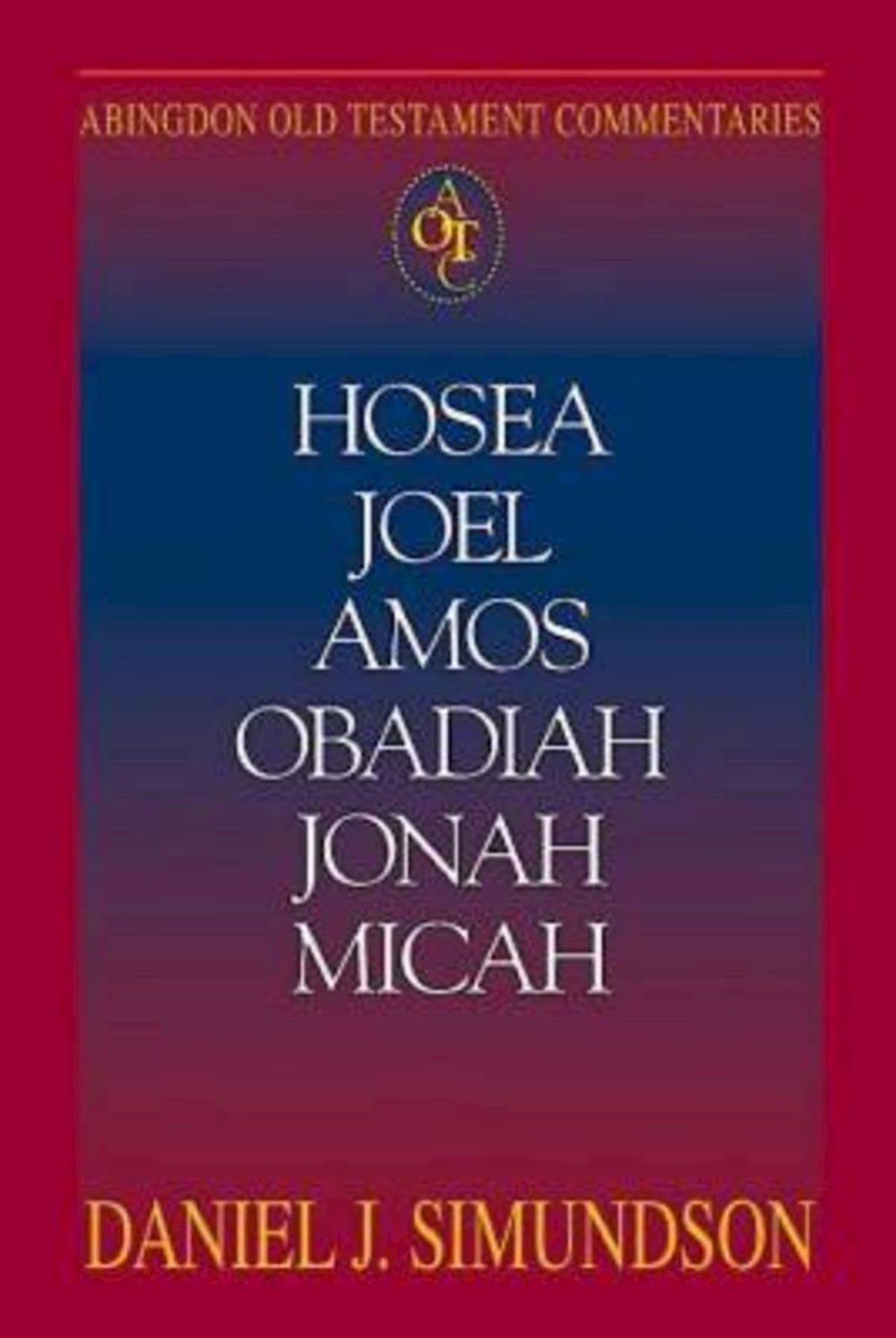
Description
The Abingdon Old Testament Commentaries provide compact, critical commentaries on the books of the Old Testament for the use of theological students and pastors. The commentaries are also useful for upper-level college or university students and for those responsible for teaching in congregational settings. In addition to providing basic information and insights into the Old Testament writings, these commentaries exemplify the tasks and procedures of careful interpretation to assist students of the Old Testament in coming to an informed and critical engagement with the biblical texts themselves. The prophetic books gathered together in the book of the Twelve are sometimes called the "minor" prophets because of their relatively small size when compared with Isaiah, Jeremiah, and Ezekiel. They are often neglected, at least partly because their words of judgment make the reader uncomfortable. Yet they have considerable theological and ethical value--for their call for social justice (especially Amos and Micah), their insights about the passionate love of God (in Hosea), God's grace and forgiveness (Jonah, Hosea, and elsewhere), and the finality of hope, even in the face of terrible catastrophes. "Those who preach and teach on these prophetic books will find here a valuable friend for their times of preparation." Recently retired from Luther Seminary in St. Paul, Mn after thirty-one years as a professor of Old Testament. He also served as the academic dean at Luther. His publications include, Faith under Fire, The Message of Job, and the commentary on Micah in the New Interpreters' Bible. Professor of Old Testament, Candler School of Theology, Emory University William Marcellus McPheeters Professor of Old Testament, Columbia Theological Seminary, Decatur, GA 30030 Princeton Seminary Carolyn Pressler is Harry C. Piper Professor of Biblical Interpretation at United Theological Seminary of the Twin Cities and an ordained minister in the United Church of Christ. Abingdon Old Testament Commentaries: Hosea, Joel, Amos, Obadiah, Jonah, Micah By Daniel J. Simundson Abingdon Press Copyright © 2005 Abingdon Press All rights reserved. ISBN: 978-0-687-34244-0 Contents Foreword, Introduction: Hosea, Commentary: Hosea, Introduction: Joel, Commentary: Joel, Introduction: Amos, Commentary: Amos, Introduction: Obadiah, Commentary: Obadiah, Introduction: Jonah, Commentary: Jonah, Introduction: Micah, Commentary: Micah, Bibliography, CHAPTER 1 Commentary: Hosea Marriage, Rejection, and Reconciliation ( chs. 1 –3) The first three chapters of Hosea gather material about Hosea's marriage and children, following the editorial heading in 1:1. This section provides the only information available about who Hosea was, when he lived, and a few details about his marriage and children. Any other understanding of Hosea must be inferred from the message that he proclaims. Hosea's own relationship with his wife becomes a metaphor for God's relationship with God's covenant people. Literary Analysis The only narrative passages in the book are in 1:2-9 and 3:1-5. The latter is the only autobiographical statement. Chapter 2 is a long poetic section. Poetry is the usual vehicle for prophetic speech. It comes between the narrative passages and draws a parallel between Hosea's marital difficulties and the relationship between God and Israel. The verse numbering in English Bibles is different from the numbering in the Hebrew Bible. In Hebrew, chapter 1 ends with verse 9 and chapter 2 begins with verse 10. Chapter 2, verse 1 in English is actually 2:3 in Hebrew. As a result, chapter 2 in Hebrew has twenty-five verses rather than twenty-three. This commentary will use the verse numbers of the English Bible, but if one wishes to refer to the Hebrew Bible, this differential needs to be noted. At the beginning of chapter 2 , the reader may be uncertain who is speaking. Since chapter 1 tells about Hosea's marriage to Gomer, one might assume that Hosea is the speaker who will reject and shame his wife. At least by 2:8, it is clear that the speaker is actually God. What began as an account of Hosea and his wife has now become a statement about the Lord and his adulterous wife, Israel. The feelings and thoughts of God and the prophet are parallel. What Hosea has experienced, God has also endured. The prophets of the Bible were so deeply involved with God and their message that sometimes it is hard to know if the prophet or God is speaking. In some cases there is a gradual, even subtle, transition from the prophet's words to God's. A good example of this is in Jer 8:18–9:3 and possibly in Amos 5:1-3. A swing back and forth from doom to hope, rejection to redemption, occurs in both chapters 1 and 2. Words of doom in 1:2-9 are followed by promises of restoration in 1:10–2:1. Proclamation of rejection and shaming in 2:2-13 is quickly alleviated by assurance that God has not given up and will renew the
More Information
| Gtin | 09780687342440 |
| Mpn | Black & White Illustrations |
| Age_group | ADULT |
| Condition | NEW |
| Gender | UNISEX |
| Product_category | Gl_book |
| Google_product_category | Media > Books |
| Product_type | Books > Subjects > Religion & Spirituality > Christian Books & Bibles > Bible Study & Reference > Commentaries > Old Testament |