
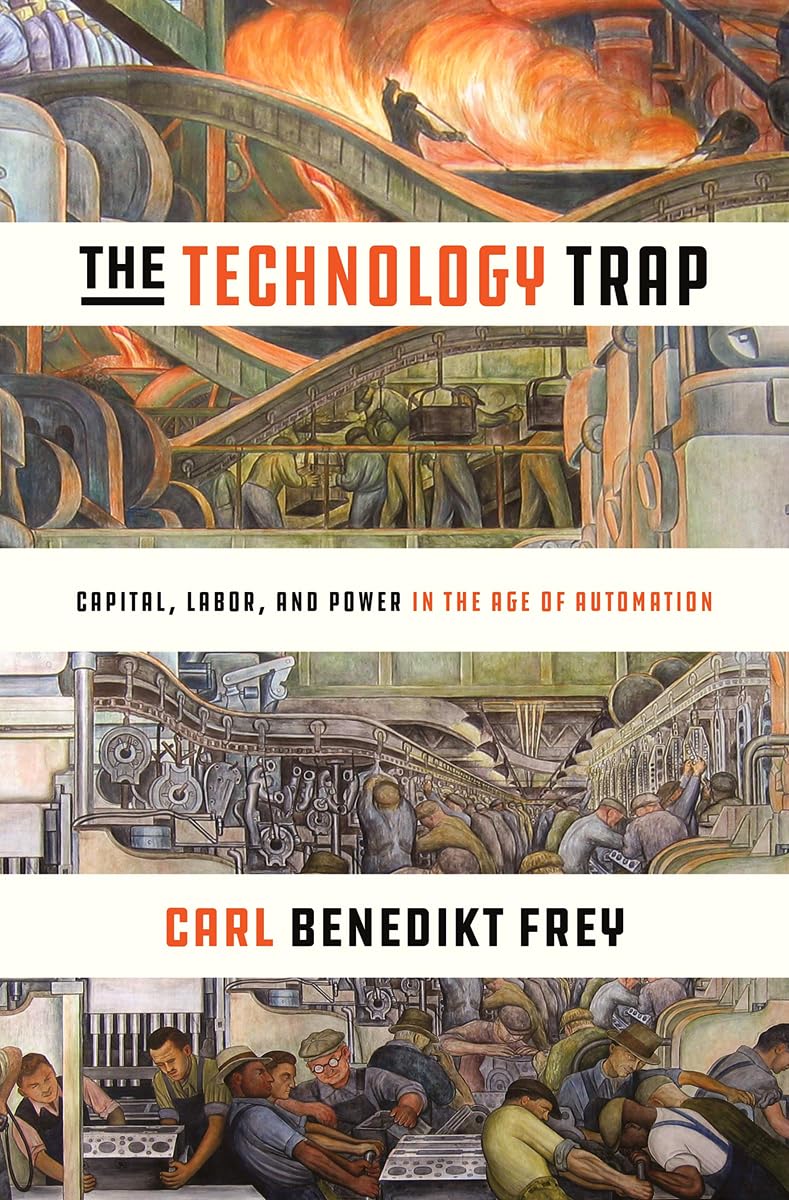
Description
"Made me look at the industrial revolution, invention, sleeping beauties, contexts and the forces that shape our societies differently."―David Byrne, New York Times Book Review How the history of technological revolutions can help us better understand economic and political polarization in the age of automation From the Industrial Revolution to the age of artificial intelligence, The Technology Trap takes a sweeping look at the history of technological progress and how it has radically shifted the distribution of economic and political power among society’s members. As Carl Benedikt Frey shows, the Industrial Revolution created unprecedented wealth and prosperity over the long run, but the immediate consequences of mechanization were devastating for large swaths of the population. Middle-income jobs withered, wages stagnated, the labor share of income fell, profits surged, and economic inequality skyrocketed. These trends, Frey documents, broadly mirror those in our current age of automation, which began with the Computer Revolution. Just as the Industrial Revolution eventually brought about extraordinary benefits for society, artificial intelligence systems have the potential to do the same. But Frey argues that this depends on how the short term is managed. In the nineteenth century, workers violently expressed their concerns over machines taking their jobs. The Luddite uprisings joined a long wave of machinery riots that swept across Europe and China. Today’s despairing middle class has not resorted to physical force, but their frustration has led to rising populism and the increasing fragmentation of society. As middle-class jobs continue to come under pressure, there’s no assurance that positive attitudes to technology will persist. The Industrial Revolution was a defining moment in history, but few grasped its enormous consequences at the time. The Technology Trap demonstrates that in the midst of another technological revolution, the lessons of the past can help us to more effectively face the present. "Co-Winner of the Silver Medal in Business Technology, Axiom Business Book Awards" "One of the Financial Times' Summer Books of 2019: Business" "One of the Financial Times' Best Books of 2019: Technology" "12 must-read books for 2019 as recommended by Tech Crunch's Extra Crunch readers" "One of Five Books' Best Economics Books of 2019" "University of Chicago 2019 Recommended Reading" "One of Handelsblatt's Best Technology Books of 2019" "One of Época Negócios's Best Books of 2019" "A Choice Outstanding Academic Title of the Year" "A Project Syndicate Best Read in 2019" "A Financial Times Best Book of the Year" "Winner of the Richard A. Lester Prize for the Outstanding Book in Industrial Relations and Labor Economics, Industrial Relations Section of Princeton University" "A superb guide to 21st-century automation and its disruptive effects." ---John Harris, The Guardian " The Technology Trap may well ensnare doom-seekers’ attention with its ominous-sounding title. But it should ultimately hearten anyone who reads it." ― The Economist "Anybody interested in the economic impact of digital and AI, in particular on jobs, will want to read [ The Technology Trap ]." ---Diane Coyle, Enlightened Economist "[Frey] takes a provocative, original long view on current concerns, examining the fallout from past technological advances . . . to mass production and artificial intelligence." ---Andrew Hill, Financial Times, Summer Books of 2019 "I have been lost in [ The Technology Trap ] for the last 10 days." ---John Harris, The Guardian "Frey’s analysis is worth taking seriously because the Oxford economic historian and economist has researched his subject deeply and has co-authored one of the most widely cited studies on automation . . . . Frey’s story is well argued and ― at times ― deeply alarming about the stability of western democracies given he predicts the further concentration of wealth in a few hands and in even fewer locations" ---John Thornhill, Financial Times "An excellent analysis of past industrial revolutions, the technologies that emerged within them, and the way societies adapted to those changes." ---Adi Gaskell, Forbes "As [Frey] points out in his new book The Technology Trap, for all that the robots may make the world more local, they may have other painful side-effects, putting millions of people out of work and sparking an almighty backlash." ---Ed Conway, The Times " The Technology Trap is the perfect book for higher ed people to read . . . . deeply researched and [convincingly] argued." ---Joshua Kim, Inside Higher Education "If you're an optimist about the robotic future, you likely hear talk that we're all going to lose our jobs or suffer a big pay cut, and tell friends to relax ― the new technology revolution is going to turn out like all the others since the dawn of the Industrial Age. But if history is your best hope, you should prob
More Information
| Gtin | 09780691172798 |
| Mpn | 54470386 |
| Age_group | ADULT |
| Condition | NEW |
| Gender | UNISEX |
| Product_category | Gl_book |
| Google_product_category | Media > Books |
| Product_type | Books > Subjects > Computers & Technology > Computer Science > AI & Machine Learning > Intelligence & Semantics |