
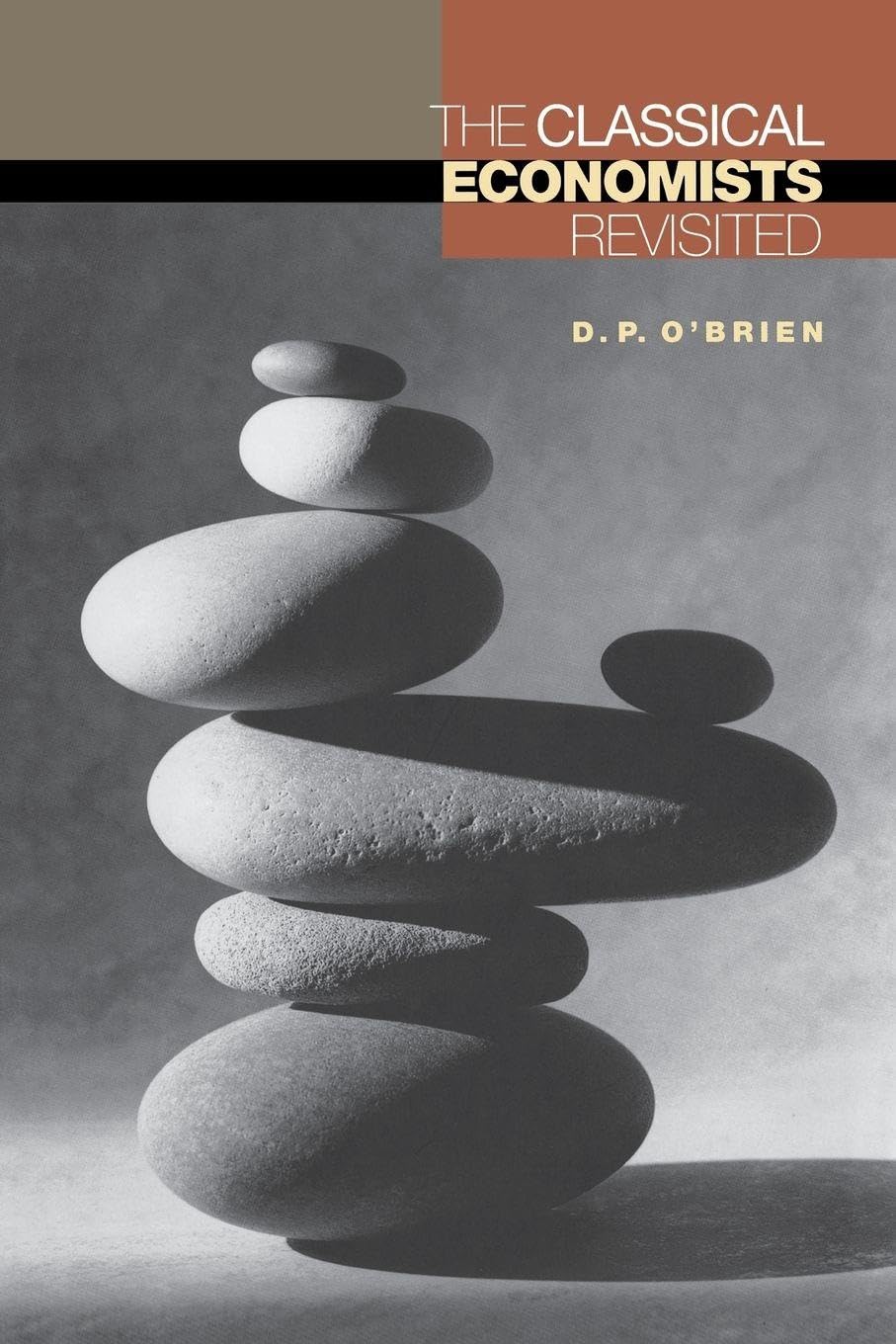
Description
The Classical Economists Revisited conveys the extent, diversity, and richness of the literature of economics produced in the period extending from David Hume's Essays of 1752 to the final contributions of Fawcett and Cairnes in the 1870s. D. P. O'Brien thoroughly updates, rewrites, and expands the vastly influential work he first published in 1975, The Classical Economists . In particular, he sets out to make clear the shaping of a comprehensive vision of the working of an open economy, building on the great work of Adam Smith in Wealth of Nations , a development that was substantially affected by the contributions of David Ricardo. He shows that the Classical literature was in fact the work of a host of thinkers from a wide range of backgrounds. Covering the intellectual roots of the Classical literature and its methodological approaches, and the developed theories of value, distribution, money, trade, population, economic growth, and public finance, and examining the Classical attitudes toward a rich variety of policy issues, The Classical Economists Revisited considers not only the achievements of the Classical writers but also their legacy to the later development of economics. A seminal contribution to the field, this book will be treasured for many years to come by economists, historians of economics, instructors and their students, and anyone interested in the sweeping breadth and enduring influence of the classical economists. "The phrase tour de force is overused, but this is a work that clearly merits it. There is no greater living authority on classical economics than D. P. O'Brien." ---Steven Medema, Editor of, Journal of the History of Economic Thought "[F]rom now on all histories of economic thought can start their story in 1870, because it is difficult to see how anyone can improve on Professor O'Brien's analysis of the century that preceded it." ---Mark Blaug, Economica "[O]ne of the more appealing aspects of this excellent book is that Professor O'Brien does not always expect his readers to agree with him, but rather sets out to provide them with the means of forming their own opinions." ---A. S. Skinner, The Economic Journal "This is not a simple textbook treatment of the issues, but rather a scholarly dissection of each topic that draws on both the prominent and more obscure writers of the time. . . . [T]he careful reader will come away with a wealth of information and a sense that the struggles through which economic theory came were long, often convoluted, and always a process in which many people participated." ― Choice D. P. O'Brien , Professor Emeritus of Economics at the University of Durham, is the author or editor of many books, including J. R. McCulloch and Thomas Joplin and Classical Macroeconomics . The Classical Economists Revisited By D. P. O'Brien PRINCETON UNIVERSITY PRESS Copyright © 2004 Princeton University Press All rights reserved. ISBN: 978-0-691-17798-4 Contents Preface to the Second Edition, xi, Preface to the Original Edition, xiii, Introduction, xv, Chapter One The Classical Economic Stage, 1, Chapter Two The Roots of Classical Economics, 26, Chapter Three The Characteristics and Preconceptions of Classical Economics, 63, Chapter Four Classical Value Theory, 91, Chapter Five The Classical Theory of Distribution, 127, Chapter Six Classical Monetary Theory, 165, Chapter Seven International Trade, 205, Chapter Eight The Classical Theory of Growth and Development, 248, Chapter Nine Classical Public Finance, 288, Chapter Ten The Policy Prescriptions of Classical Economics, 327, Chapter Eleven Classical Economics: A Retrospect, 356, Notes, 363, Index, 405, CHAPTER 1 The Classical Economic Stage I. The Period of Classical Economics In any detailed discussion of a particular body of ideas, it is perhaps helpful to begin by indicating to the reader the period during which those ideas were of importance. There can be little doubt that the heyday of Classical economics was during the years 1800–1850. Delineation of the period during which Classical economics developed as a body of thought, came to be the ruling approach to economics, ultimately experienced a measure of stagnation and decay, and was finally supplanted by the young and vigorous development of neo-Classical economics in the "Marginal Revolution," is however a good deal less easy. At one end it is usual to date the era of Classical economics as beginning in 1776, with the publication of Adam Smith's mighty Wealth of Nations. Such an approach has a strong prima facie appeal, but closer examination raises doubts about it. On the one hand Classical economics owed a great deal to David Hume in certain critical areas, especially that of monetary theory. The relevant part of Hume's Essays was published in 1752; and it is therefore doubtful if too much weight can be placed on the year 1776. Indeed the influence of Hume upon Smith cannot be i
More Information
| Gtin | 09780691177984 |
| Mpn | Refer To Sapnet. |
| Age_group | ADULT |
| Condition | NEW |
| Gender | UNISEX |
| Product_category | Gl_book |
| Google_product_category | Media > Books |
| Product_type | Books > Subjects > Business & Money > Economics > Economic History |