
Description
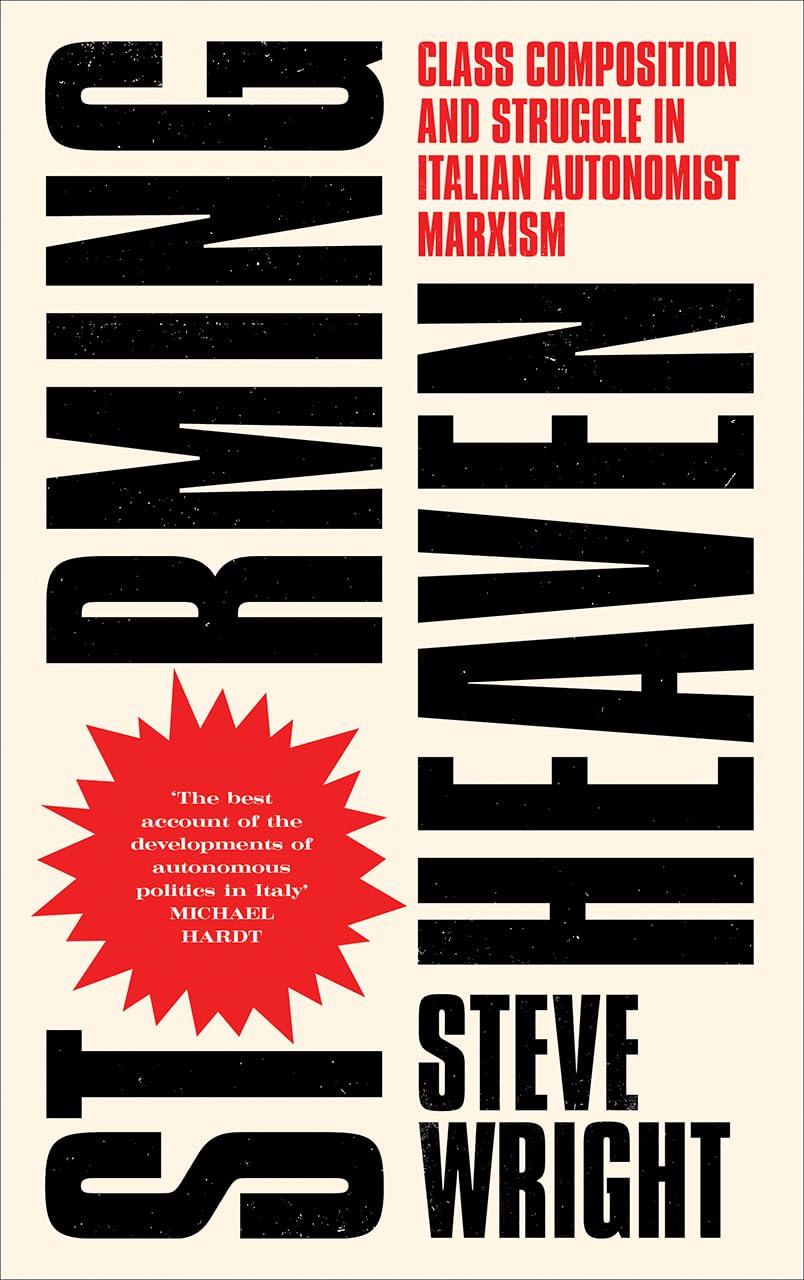
The only comprehensive survey of Italian autonomist theory, Storming Heaven explores its origins in the anti-Stalinist left of the 1950s and traces it through its glory days twenty years later. Emphasizing the dynamic nature of class composition and struggle as the distinguishing feature of autonomist thought, Steve Wright documents how class politics developed alongside emerging social movements. A critical and historical exploration of autonomist Marxism in postwar Italy, Storming Heaven moves beyond traditional analytical frameworks and instead assesses the strengths and limitations of the theory and how it foreshadowed many of contemporary European social struggles, such as the refusal of work, self-organization, openness to non-militarized political violence, mass illegality, and the extension of revolutionary agency. This updated edition also offers a substantial new afterword looking at the recent debates around operaismo and autonomia in Italy. "The best account in English of the developments of autonomous politics in Italy in the 1960s and 70s." ― Michael Hardt co-author of Empire "As the most wide-ranging, historically nuanced and theoretically incisive treatment of the contested tradition of operaismo, Wright's book is an indispensable contribution to the study, critique or revitalisation of Italy's foremost contribution to Marxian heterodoxy." ― Alberto Toscano, Goldsmiths, University of London "A vital, lucid contribution to understanding how the red threads of Marxism are being rewoven into the fabric of twenty-first century radicalism." ― Nick Dyer-Witheford, author of Cyber-Proletariat: Global Labour in the Digital Vortex 'The best account in English of the developments of autonomous politics in Italy in the 1960s and '70s' 'As the most wide-ranging, historically nuanced and theoretically incisive treatment of the contested tradition of operaismo, Wright's book is an indispensable contribution to the study, critique or revitalisation of Italy's foremost contribution to Marxian heterodoxy' 'A vital, lucid contribution to understanding how the red threads of Marxism are being rewoven into the fabric of twenty-first century radicalism' Steve Wright is a senior lecturer the faculty of information technology at Monash University, in Australia. Storming Heaven Class Composition and Struggle in Italian Autonomist Marxism By Steve Wright Pluto Press Copyright © 2017 Steve Wright All rights reserved. ISBN: 978-0-7453-9990-4 Contents Foreword by Harry Cleaver, vi, Acknowledgements, xii, Introduction, 1, 1. Weathering the 1950s, 5, 2. Quaderni Rossi and the Workers' Enquiry, 29, 3. Classe Operaia, 58, 4. New Subjects, 82, 5. The Creeping May, 98, 6. Potere Operaio, 120, 7. Toni Negri and the Operaio Sociale, 140, 8. The Historiography of the Mass Worker, 163, 9. The Collapse of Workerism, 183, 10. Conclusion, 208, Postscript: Once More, With Feeling: A Bibliographic Essay, 212, Afterword to the Italian Edition by Riccardo Bellofiore and Massimiliano Tomba, 237, Bibliography, 249, Index, 278, CHAPTER 1 Weathering the 1950s 'So-called operaismo ', noted Antonio Negri a year or so before his arrest in April 1979, had emerged above all 'as an attempt to reply politically to the crisis of the labour movement during the 1950s' (Negri 1979a: 31). A worldwide phenomenon, this crisis proved especially serious in Italy, where the crushing of revolutionary Hungary and the collapse of the Stalin myth dovetailed with a domestically induced malaise already hanging over much of the left. Together these dislocations were to become the primary concerns of a new approach to Marxism which would both anticipate the Italian new left of the 1960s and provide the soil from which workerism itself would directly spring. THE PRICE OF POSTWAR RECONSTRUCTION The 1950s were a period of profound transformation for Italian society. The aftermath of the Second World War left much of the economy, particularly in the North, in a state of chaos. Industrial production stood at only one-quarter the output of 1938, the transport sector lay in tatters and agriculture languished. A combination of inadequate diet and low income (real wages had fallen to one-fifth the 1913 level) meant that for large sectors of the population, physical survival overrode all other considerations. Yet by the end of the following decade the nation's economic situation was startlingly different, with dramatic rises in output, productivity and consumption: Italy's 'miracle' had arrived with a flourish (Clough 1964: 315; Gobbi 1973: 3). Even as those working the land declined in number, the rate of growth in the agricultural sector actually increased slightly between 1950 and 1960. From the middle of the decade, as secondary industry began to develop extensively, excess labour-power was encouraged to embark upon an internal migration from countryside to city, and above all from South to Nort
More Information
| Gtin | 09780745399904 |
| Age_group | ADULT |
| Condition | NEW |
| Gender | UNISEX |
| Product_category | Gl_book |
| Google_product_category | Media > Books |
| Product_type | Books > Subjects > Politics & Social Sciences > Politics & Government > Ideologies & Doctrines > Communism & Socialism |