
Description
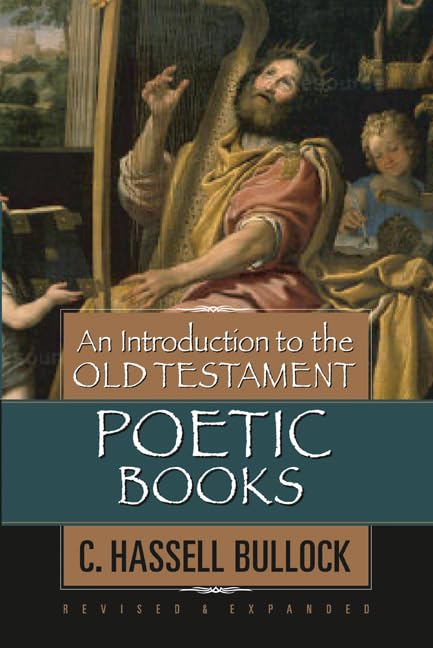
The poetic books of the Old Testament—Job, Psalms, Proverbs, Ecclesiastes, and the Song of Solomon—are often called humankind's reach toward God. The other books of the Old Testament picture God's reach toward man through the redemptive story. Yet these five books reveal the very heart of men and women struggling with monumental issues such as suffering, sin, forgiveness, joy, worship, and the passionate love between a man and woman. C. Hassell Bullock, a noted Old Testament scholar, delves deep into the hearts of the five poetic books, offering readers helpful details, like: Hermeneutical considerations for each book - Theological content and themes - Detailed analyses of each book - Cultural perspectives. Hebrew is a language of "intrinsic musical quality that naturally supports poetic expression," says Bullock in his introduction. That poetic expression comes from the heart of the Old Testament writers and reaches all of us exactly where we are in our own struggles and joys. C. HASSELL BULLOCK (B.A., Samford University; B.D., Columbia Theological Seminary; University Ph.D., Hebrew Union College-Jewish Institute of Religion) is professor of Old Testament studies at Wheaton College. Since the completion of his formal education, Dr. Bullock has served as both a professor and as a pastor in 10 different churches. He is the author of An Introduction to the Old Testament Prophetic Books, Encountering the Book of Psalms, An Introduction to the Old Testament Prophetic Books , and An Introduction to the Old Testament Poetic Books . Dr. Bullock resides in Wheaton, Illinois. An Introduction To The Old Testament Poetic Books By C. Hassell Bullock Moody Publishers Copyright © 1988 C. Hassell Bullock All rights reserved. ISBN: 978-0-8024-4157-7 Contents Preface to Second Edition, Preface to First Edition, Abbreviations, 1. Introduction, 2. The Theology of Wisdom, 3. The Book of Job, 4. The Book of Psalms, 5. The Book of Proverbs, 6. The Book of Ecclesiastes, 7. The Song of Songs, Bibliography, Index of Subjects, Index to Hebrew Words, Index of Authors, Index of Scripture, CHAPTER 1 INTRODUCTION The Old Testament books considered in this volume contain some of the most potent literature of human history, and the ideas they treat are among the most cogent that the human heart has entertained. These books are not historically oriented. In fact, with the exception of the Psalms, they are relatively devoid of historical allusions. But while they do not reflect upon historical events, they are alive with the spirit of history. They grasp for and grapple with those essential concepts that set the Hebrew faith apart from that of its neighbors and ensure its survival in a pantheistic, power-greedy world. Reflecting the essential theology of the Pentateuch, these books in general do not seek to convey directly God's word to man, as do the Prophets (e.g., "thus says the Lord"), but they entertain the questions that arise in the presence of the divine imperative. In part, the spokesmen in these five books speak for man to God (esp. in Job and many of the psalms), in contrast to the Prophets, who normally speak for God to man. Yet the book of Ecclesiastes is more a human monologue than a dialogue between man and God, whereas the Song of Songs is even more anthropocentric. Moreover, they breathe a certain universality. The problem of suffering, the conscience marred by sin, the transience of human life, and the passionate love of woman and man, to mention only a few of the matters dealt with in these books, cut across national and ethnic lines to include all of the human race. The spokesmen in these books formulate questions that have lain in man's subconscious mind, often without his having had courage to bring them to the surface. The courageous spirit of Job, Ecclesiastes, and many of the psalms, therefore, is another characteristic of this literature. It is marked frequently by a mood of challenge and skepticism, saying things that are rooted deeply in man's being. These books focus on man's reflections on God and His response rather than on God's search for man. Yet the divine Spirit hovers over man's effort to understand, to figure out his world, to fathom the meaning of his relationship to God. The theological orientation toward creation in wisdom literature is not coincidental. For to unravel the meaning of human life will lead one all the way back to its beginning. The individual and personal nature of the books that we undertake to study is evidence of the attention given in the Old Testament to the importance of the individual to God. He began the race with an individual, and His love continues to be applied personally as well as corporately. One might read the Pentateuch and see only a faint shadow of himself reflected there. The historical books may overwhelm him with facts and events. The Prophets, by some mere chance, may pass him by with their deep convictions and co
More Information
| Gtin | 09780802441577 |
| Mpn | Illustrations |
| Age_group | ADULT |
| Condition | NEW |
| Gender | UNISEX |
| Material | Cellulose-based Or Similar Non-woven Material |
| Product_category | Gl_book |
| Google_product_category | Media > Books |
| Product_type | Books > Subjects > Religion & Spirituality > Christian Books & Bibles > Bible Study & Reference > Bible Study > Old Testament |