
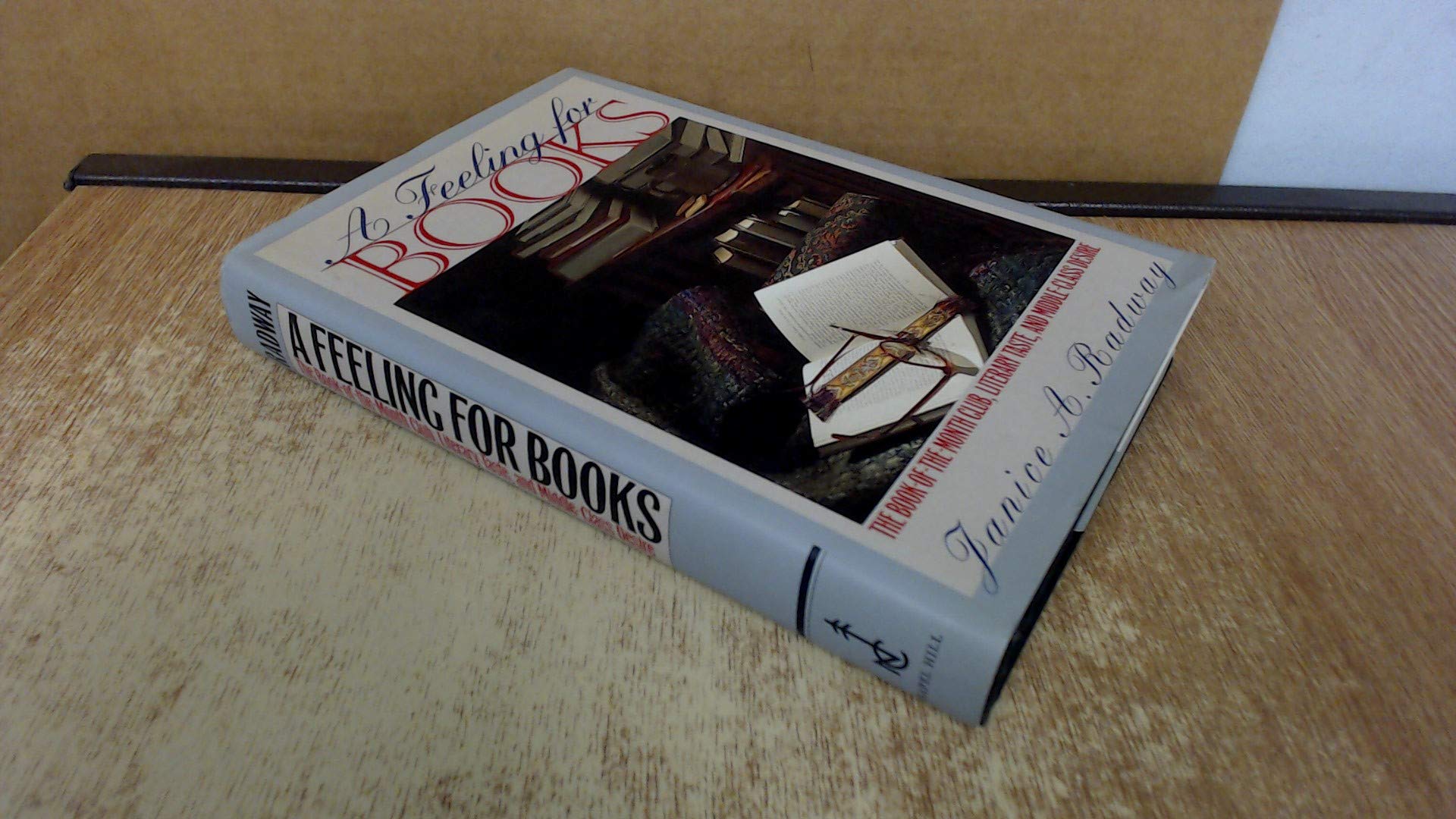
Description
Deftly melding ethnography, cultural history, literary criticism, and autobiographical reflection, A Feeling for Books is at once an engaging study of the Book-of-the-Month Club’s influential role as a cultural institution and a profoundly personal meditation about the experience of reading. Janice Radway traces the history of the famous mail-order book club from its controversial founding in 1926 through its evolution into an enterprise uniquely successful in blending commerce and culture. Framing her historical narrative with writing of a more personal sort, Radway reflects on the contemporary role of the Book-of-the-Month Club in American cultural history and in her own life. Her detailed account of the standards and practices employed by the club’s in-house editors is also an absorbing story of her interactions with those editors. Examining her experiences as a fourteen-year-old reader of the club’s selections and, later, as a professor of literature, she offers a series of rigorously analytical yet deeply personal readings of such beloved novels as Marjorie Morningstar and To Kill a Mockingbird . Rich and rewarding, this book will captivate and delight anyone who is interested in the history of books and in the personal and transformative experience of reading. A virtual self-parody of obfuscation and solipsism in cultural studies. Radway (Literature/Duke Univ.) writes that she has spent much of her career mulling ``the distance I had travelled between a small tract house in suburban New Jersey . . . and a lectern in front of a literature class.'' Radway takes this self-indulgent vision of scholarship as her license to inflate a sentimental interest in the Book-of-the-Month Club into a needlessly mystified ``ethnography'' of it. Her history of the club's creation of a middle-brow reading appetite is relatively informative if, like everything else here, overlong. But because her contemporary ``fieldwork'' approaches the club as an arcane text or exotic tribe, rather than a perfectly intelligible business enterprise, she endlessly worries the relationship between its literary and commercial goals into equivocal blather, such as, ``Decisions about books at the club were always pegged to a highly elaborated conception of book buying and book reading.'' That is to say, ``multiple planes of the literary field . . . were structured according to . . . a planar logic that foregrounded the discreteness and particularity of domains and forms of expertise.'' It will be clear to anyone but Radway that the club is just a marketing scheme with a pretty simple taste-mongering shtick, run, to judge even by her flattering portrayal, by people who sell books, not literature. But Radway is lost in breathless close readings of editorial memos, and cut-and-paste applications of cultural theory--not to mention her affection for the staff and misty memories of young book-loving. More intriguing than any book club's mail-order stratagems is the question of how books like this get sold--to Ivy League departments in the form of dissertations, grant-makers (the Guggenheim in this case), and university presses. (9 illustrations, not seen) -- Copyright ©1997, Kirkus Associates, LP. All rights reserved. “The volume has great value as a history of the Book-of-the-Month Club and of the formation of middle class culture as ‘middlebrow’ culture. It offers special insight into the techniques by which American publishers managed to commodify books as objects which claim to reach beyond the world of commodities. But it is the best book I know on the mind altering powers of reading for pleasure.” — American Quarterly “[A] complex and richly rewarding book.” — Epilogue “Essential reading for scholars interested in the history of the book and popular culture . . . engaging and sympathetic.” — American Literature “Radway has written one of the most important books in this decade. . . . Provides a persuasive explanation for a set of human behaviors librarianship cannot ignore if it expects to prepare a prudent and democratic agenda for the next century.” — Libraries and Culture “[Radway’s] book is ambitious and engrossing, and it leaves us with much to ponder.” — Washington Post Book World “What [Radway] sees most clearly is how those middlebrow books she read in her childhood gave her the appetite to keep on reading, until her mind grew powerful enough to produce this deeply penetrating book, which not only lays bare the forces that produced middlebrow reading but also explains a good deal of what is going on in the world of books today.” — Christopher Lehmann-Haupt, New York Times “A revealing and subtle account of the club’s business history and its cultural history. . . . This is a rich and absorbing study of the social formation of literary taste.” — Journal of American History “The story that . . . unfolds is fascinating, and the cultural implications it touches on important.” — The Georgia Review “Th
More Information
| Gtin | 09780807823576 |
| Age_group | ADULT |
| Condition | NEW |
| Gender | UNISEX |
| Product_category | Gl_book |
| Google_product_category | Media > Books |
| Product_type | Books > Subjects > Literature & Fiction > History & Criticism > Books & Reading > History Of Books |