
Description
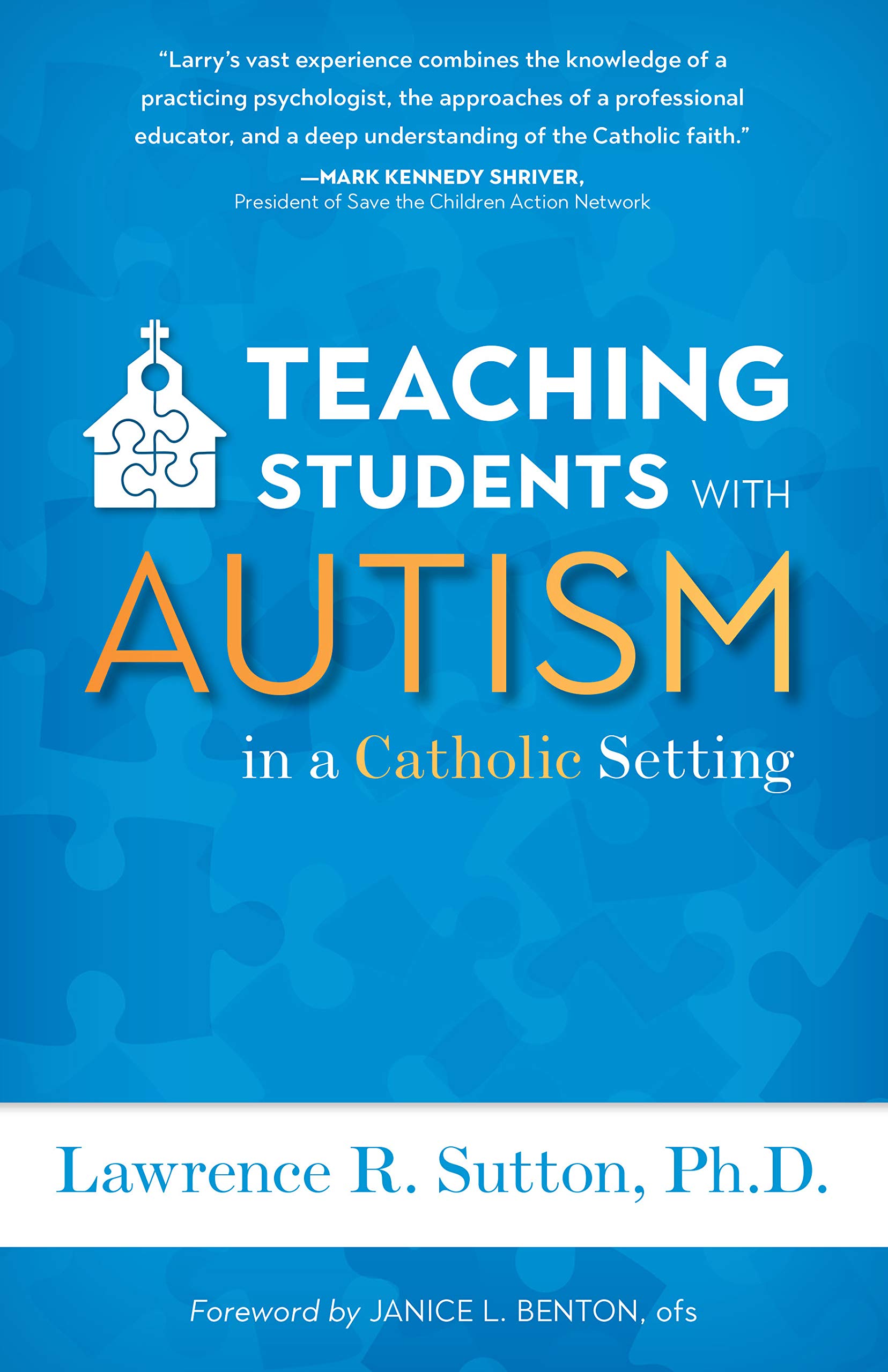
2021 Illumination Book Awards, Gold Medal: Education Are you looking for a comprehensive guide to equip you with the tools, knowledge, and strategies you need to better understand and effectively respond to children with autism? In Teaching Students with Autism in a Catholic Setting, Deacon Larry Sutton draws on case studies, personal experiences, and best practices to provide educators with the necessary skills and strategies to identify and respond to the needs of their students with autism. This guide will help people working with children with autism to: use best practices to manage behavior to enhance their educational experience - gain insight into how to reduce some of the challenges that these children face - identify and cultivate the gifts and strengths these children possess to prepare them for the future Grounded in the Catholic principle that every person has dignity and possesses gifts to be shared with the greater community, Teaching Students with Autism in a Catholic Setting will empower you to become an agent of God's grace in improving the lives of children with autism. Lawrence R. Sutton, Ph.D., is an ordained deacon and a psychologist specializing in developmental disabilities, especially autism spectrum disorders. He is the former Manager of the Western Region Office of the Pennsylvania Bureau of Autism Services and is currently the Director of the Pre-Theologian Formation program and teacher at St. Vincent College. He is nationally recognized for developing his own methodology for providing religious education to children with special needs. Chapter 1: Students Who Learn Differently As a body is one though it has many parts, and all the parts of the body, though many, are one body, so also Christ. For in one Spirit we were all baptized into one body, whether Jews or Greeks, slaves or free persons, and we were all given to drink of one Spirit. . . . But God has so constructed the body as to give greater honor to a part that is without it, so that there may be no division in the body, but that the parts may have the same concern for one another. If [one] part suffers, all the parts suffer with it; if one part is honored, all the parts share its joy. —1 Corinthians 12:12–13, 24–26 The Learner with Autism and the Catholic School Educating someone with autism doesn’t need to be difficult. Students with autism are similar to neurotypical students in many ways. Children with autism, for example, are often proficient problem solvers. They can also have preferred areas of interest and are good in some subjects and not so good in others. However, many students are easily affected by the environment around them. These students seem to learn differently from neurotypical learners. Many learners with autism can (and do) grow up and develop friendships with their peers and can lead happy, productive lives as adults. Sometimes having this disorder may overshadow the gifts that each learner likely has. Because of the wide nature of autism as a spectrum disorder, one person with autism could have a limited intellectual ability while another could be gifted intellectually; one may understand mathematics after only one explanation and quickly become bored when repetitive problems are assigned to them, while another might struggle and seem never to understand a mathematical concept. Some children with autism excel in mathematics, others in science or in art. As with every child, each individual is different. Learners with autism don’t always recognize the connection between similar ideas and objects. Therefore, they appear to be more concrete learners, often applying one concept to another without recognizing the differences in context, or they cannot make the connection between two similar concepts. In this way, they may seem to lack insight and may appear to lack abstract thinking processes. Moreover, they may appear as if they should know something because of its similarity to another concept when they clearly don’t. For example, some young learners may learn that two plus two equals four, but don’t recognize and need to learn that three plus one equals four as well. In a similar sense, many individuals with autism find it difficult when similar sounding words have different meanings, such as the word read , which sounds similar to red . Both sound the same in some contexts (I read the book or the red book), but, as they cannot generalize concepts well, those with autism need to learn the specific rules for the use of a word as opposed to other words that sound the same when they have two or more meanings independently. The Call for Inclusion and Belonging As a Catholic community, we are called to recognize and respond to those around us as children of God, regardless of race or culture, ability or disability. This call for inclusion is clearly expressed by the United States Conference of Catholic Bishops, The Church continues to affirm the dignity of eve
More Information
| Gtin | 09780829447071 |
| Age_group | ADULT |
| Condition | NEW |
| Gender | UNISEX |
| Product_category | Gl_book |
| Google_product_category | Media > Books |
| Product_type | Books > Subjects > Education & Teaching > Schools & Teaching > Special Education > Behavioral Disorders |