
Description
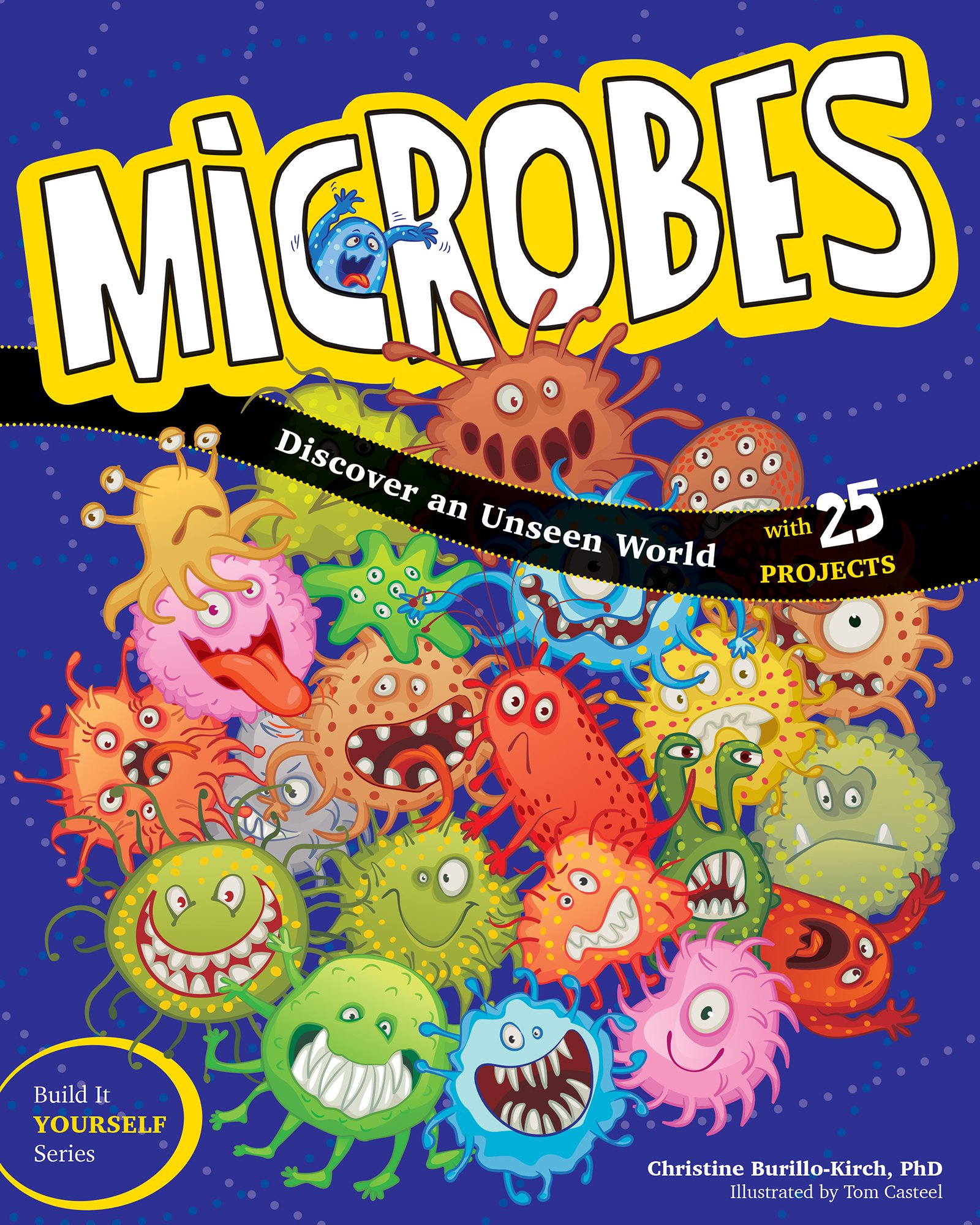
If our vision improved one million times, we would be able to see microbes in the air, on our skin, in the soil, in water, and on food! In Microbes: Discover an Unseen World , readers journey through microscopic worlds that collide with our own on a daily basis to encounter bacteria, viruses, fungi, protists, and archaea. There are some microbes we can’t live without, such as those that help us digest our food, while others can harm or even kill us, such as influenza and ebola. Microbes looks at some of the ways the body protects itself from diseases and infections through critical thinking exercises that explore the differences between harmful and beneficial microbes. Follow in the footsteps of the scientists who had both the genius and the imagination to research and discover microbes. Hands-on experiments such as building a mini incubator, making bacterial growth plates, and growing fungi allow children to explore their microbiological surroundings safely while employing the scientific method to discover details about microbes. Fun facts and primary sources make learning fun and integrative, while cartoon illustrations engage kids' imaginations and prod their natural curiosity about this weird and fascinating topic. Praise for other books in the series Backyard Biology: Investigate Habitats Outside Your Door with 25 Projects Publishers Weekly "This addition to the Build It Yourself series incorporates 25 projects for kids to try as they explore the ecosystems that are outside your door. Latham’s accessible, encouraging tone, along with such experiments as creating habitats for woodlice (aka roly-polies) and building bird nests using natural materials, should pique kids’ interest and get them outdoors. " Backyard Biology: Investigate Habitats Outside Your Door with 25 Projects School Library Journal :"This resource guide contains a wealth of information and challenging activities for budding scientists. It provides nature projects that can easily be implemented and includes growing microbes, molds, and yeasts; engaging in chemical chromatography; and learning what average people can do to protect neighborhood habitats. A good choice for science collections Science Books & Films 2016 Best Books List Science Books & Films ++: Highly Recommended ”was very impressed with the quality of this book. The design and illustrations are great, while the book and information are very well organized and include great detail. It includes a very good historical introduction and it transitions from simple concepts and experiments to more advanced material in a very smooth manner. The charts and illustrations included are very helpful and easy to understand for the reader. This book is a great way to introduce young scientists to the scientific method and it allows for easy experimentation to be carried out at home (or in the classroom) for students of all backgrounds (economic and otherwise). I was unable to find any issues with this book. I could see this book being used for grades 5-8. It would be a great start to help students build a science fair project using the methods described and getting them involved in their school's fair. I think this book also can be used for reference in the classroom. Overall, this book is a great educational tool for the students. I am very pleased with the contents. Booklist : "Making microbes an engaging topic for young readers is no easy task, but by marshaling comic-book-style illustrations and plenty of relatable examples, this book will be an appealing choice for the science classroom and the library shelf. . . this is sure to engage young biologists.” Puget Sound Council for the Review of Children’s Media : Highly Recommended -- Superior book everyone should buy. This is the ideal book for students who want to know more about microbes than they are learning in the classroom. Part textbook, part experiment project book, colorful, fun, and animated Microbes is easy to follow and goes in depth into various parts of the science: the scientists behind discoveries of microbes, illnesses and disease, and cures and antibodies. Each chapter has an essential question that is written both at the beginning and the end. Students are encouraged to reflect on what they have learned by keeping scientific journals (the scientific method is spelled out as well). At the end of each chapter are three different experiments that children can perform on their own (if there is any potential danger, the author notes that parental help is advised). Several QR codes are available so the reader can take a closer look at a microbe, pathogen, etc. Table of contents, index, resources used to write this book, recommended web sites and books, metric equivalent chart, and QR code index (in case the scanner does not work) all serve to round out the amazing science book!” < Jeffrey C. Mocny, PhD, Senior Principal Scientist : “Dr. Kirch has done a wonderful job bringing scien
More Information
| Gtin | 09781619303065 |
| Mpn | Color Illustrations Throughout, Charts T |
| Age_group | ADULT |
| Condition | NEW |
| Gender | UNISEX |
| Material | Cellulose-based Or Similar Non-woven Material |
| Product_category | Gl_book |