
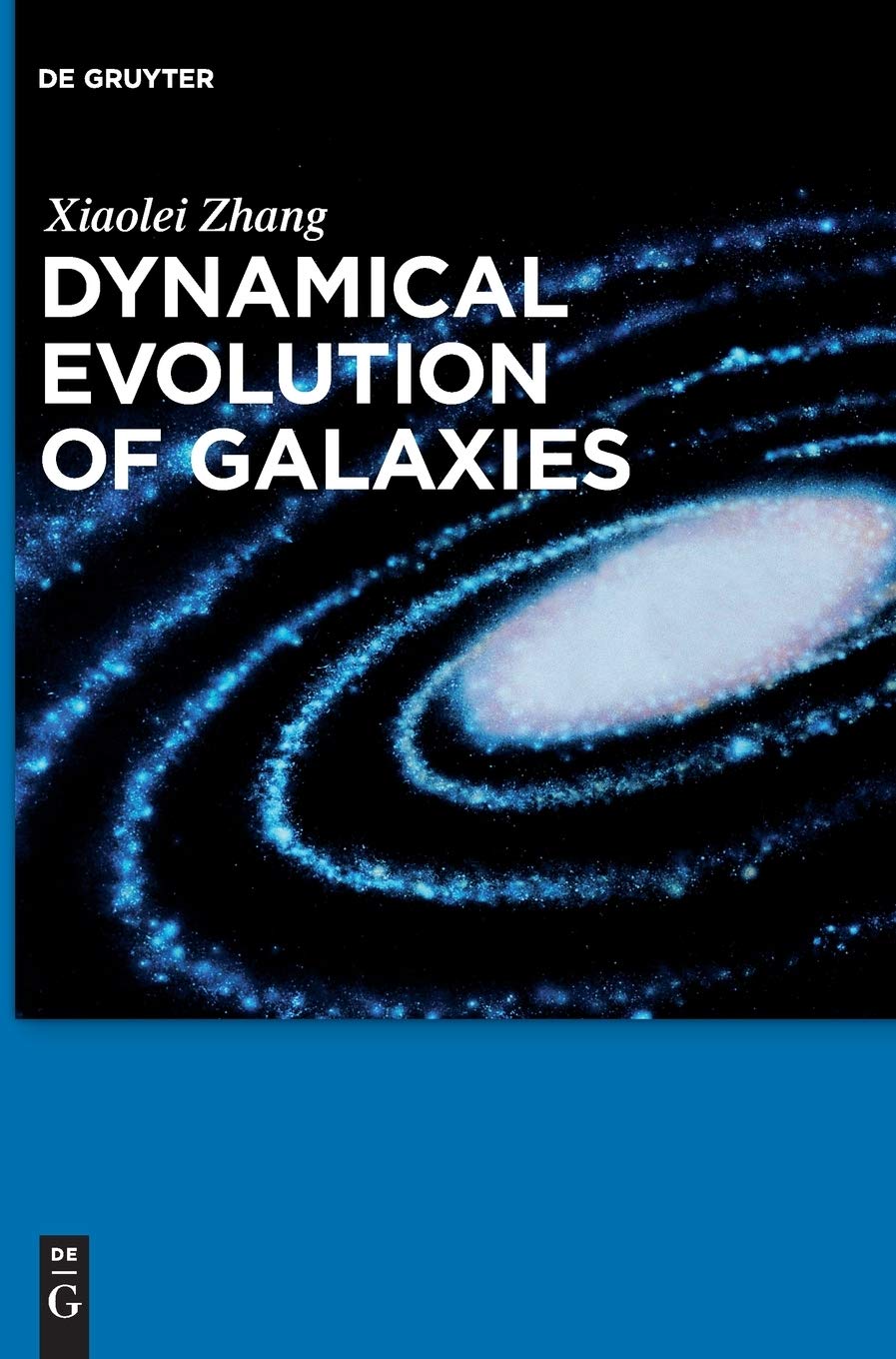
Description
This research monograph presents a new dynamical framework for the study of secular morphological evolution of galaxies along the Hubble sequence. Classical approaches based on Boltzmann's kinetic equation, as well as on its moment-equation descendants the Euler and Navier-Stokes fluid equations, are inadequate for treating the maintenance and long-term evolution of systems containing self-organized structures such as galactic density-wave modes. A global and synthetic approach, incorporating correlated fluctuations of the constituent particles during a nonequilibrium phase transition, is adopted to supplement the continuum treatment. The cutting-edge research combining analytical, N-body simulational, and observational aspects, as well as the fundamental-physics connections it provides, make this work a valuable reference for researchers and graduate students in astronomy, astrophysics, cosmology, many-body physics, complexity theory, and other related fields. ContentsIntroductionDynamical Drivers of Galaxy EvolutionN-Body Simulations of Galaxy EvolutionAstrophysical Implications of the Dynamical TheoryPutting It All TogetherConcluding RemarksAppendix: Relation to Kinetics and Fluid Mechanics "It has been a great pleasure for me to review the book Dynamical Evolution of Galaxies by Dr. Xiaolei Zhang. I regard this book as a BEAUTIFUL piece of work, which will inspire the new generation of astrophysicists, providing them with a deeper and wider understanding of galaxy dynamics. This is a cross-disciplinary field that has a variety of connections with fundamental aspects of physics. The author is one of the leading authorities in this field and, to the best of my knowledge, she is a pioneer in the exploration of how galaxy dynamics and fundamental physics are connected. Rather than being a competitor, this book will be a *very useful* complement to the books Galactic Dynamics by Binney & Tremaine (2008) and Dynamics of Galaxies by Bertin (2014). All courses adopting those books will also benefit from this new book!" -- Prof. Alessandro Romeo, Chalmers University of Technology, Gothenburg, Sweden "Galaxies are some of the most numerous astronomical objects we can observe, so the study of internal processes that determine their structural features and physical properties provides a clue to understanding the evolution of the observable universe. The author successfully combines the analytical approach, the technique of numerical simulations and available observational data to demonstrate the complex dynamic behavior of stellar and gas components of galaxies and the role of self-organizing processes in their evolution. This is a brilliant book which is invaluable for all those who are interested in understanding the evolution of galaxies and the dynamics of self-gravitating stellar systems." -- Anatoly Zasov, Professor of Astronomy, The Sternberg Astronomical Institute of the Moscow State University, Russia. The spontaneous breaking of symmetry and the associated spontaneous emergence of laws are important conceptual cornerstones of modern physics. So far, most studies in this context were carried out using model Lagrangian functions. These include the celebrated Standard Model of elementary particles and the theories of superconductivity. In these studies, the back-action of the emergence of patterns and laws to the assumed boundary condition (or the Lagrangian function itself) is ignored. This standard practice precluded the consideration of the co-evolution of laws and matter distribution in a Machian sense. The current work demonstrates for the first time the spontaneous emergence of laws in a globally self-consistent treatment, when the older laws (such as the differential form of the Poisson equation and the differential form of the fluid equations) are invalidated at the singularity shock front of a nonequilibrium phase transition. The characteristics of the emergent laws are shown to be determined by the self-organized spatial-temporal patterns; as a result the laws co-evolve with the perturbation patterns, as well as with the galactic basic-state boundary conditions. The improved understanding on the dynamical mechanisms driving the secular morphological evolution of galaxies hints at a more general need to update the classic suite of scientific methodologies, in order to be able to properly characterize nature' inherent organizational hierarchies for its laws and phenomena. Other implications of this work include a strong preference for the baryonic composition of galactic dark matter. This research monograph presents a new dynamical framework for the study of secular morphological evolution of galaxies along the Hubble sequence. Classical approaches based on Boltzmann's kinetic equation, as well as on its moment-equation descendants the Euler and Navier-Stokes fluid equations, are inadequate for treating the maintenance and long-term evolution of systems containing self-organized structures
More Information
| Gtin | 09783110525199 |
| Mpn | 48000388 |
| Age_group | ADULT |
| Condition | NEW |
| Gender | UNISEX |
| Product_category | Gl_book |
| Google_product_category | Media > Books |
| Product_type | Books > Subjects > Science & Math > Astronomy & Space Science > Astronomy |