
Description
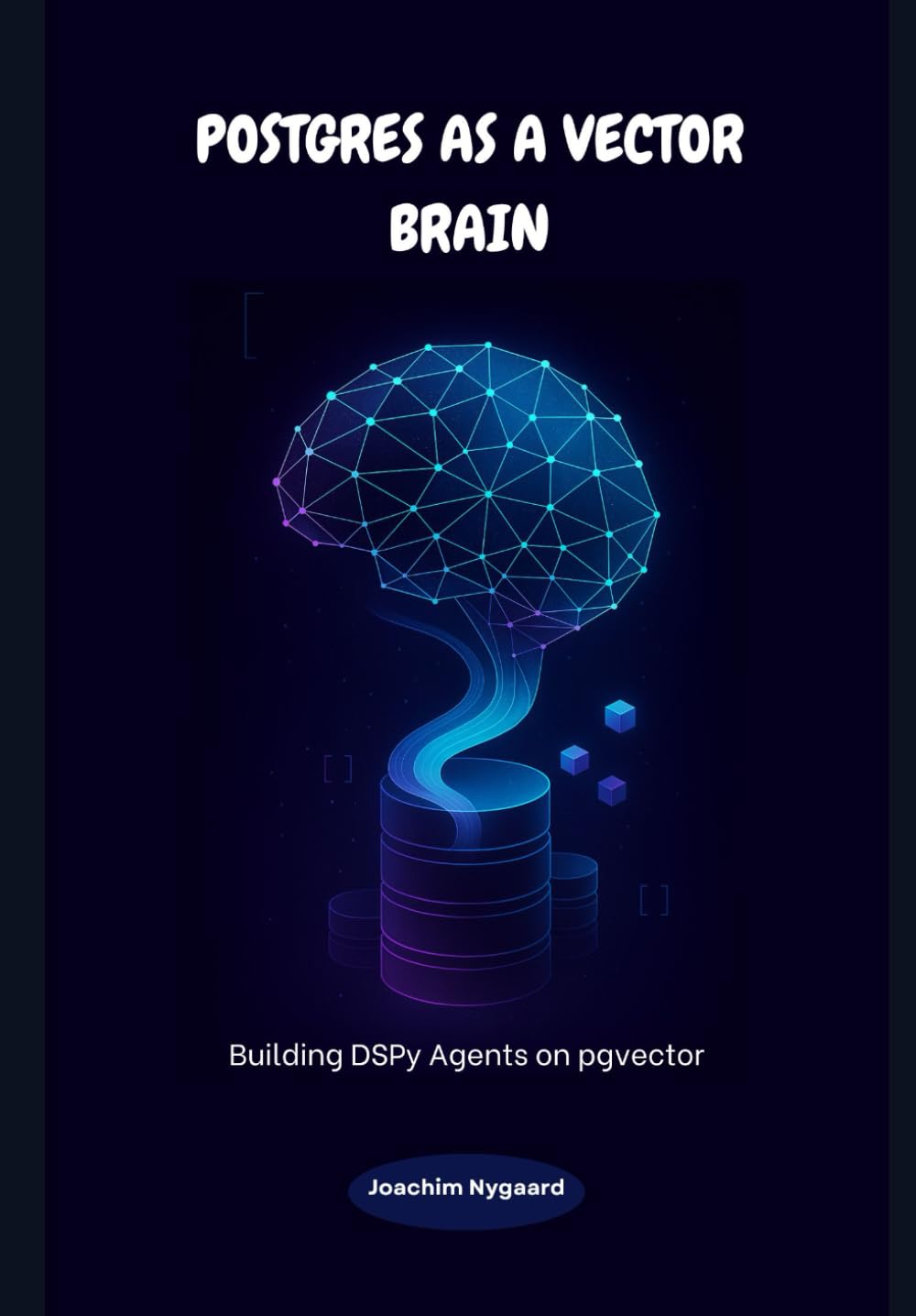
PostgreSQL has earned its place as the world’s most trusted relational database. With the pgvector extension, it also becomes a high-performance similarity engine for embeddings. Pair that with DSPy—an open, declarative framework for building modular LLM programs—and you can design agents that retrieve, reason, and act with the rigor of SQL and the flexibility of modern language models. This book shows how to treat Postgres as your “vector brain”: hybrid search (BM25 + vectors), robust schemas, row-level security, and operational discipline—joined with DSPy Signatures, Modules, and Compilers that turn prompts into reliable software. Summary “Postgres as a Vector Brain: Building DSPy Agents on pgvector” is a practical guide to building production-grade AI assistants on top of technology you already trust. You’ll learn how to ingest and embed documents, query with lexical and vector indexes, compose retrieval-optimized DSPy programs, add tool calling and policies, and ship the whole system with observability, evaluation, and guardrails. From local prototyping to enterprise rollout, you’ll get patterns, code, and playbooks that keep latency predictable, results grounded, and costs under control. What’s inside -Core schemas for documents, chunks, embeddings, metadata, and citations that scale cleanly. -Exact vs approximate search, hybrid scoring, and index choices (HNSW, IVFFlat) with clear trade-offs. -DSPy fundamentals—Signatures, Modules, Teleprompters, and Compilers—applied to retrieval, planning, and synthesis. -End-to-end ingestion pipelines: ETL, deduplication, PII scrubbing, normalization, versioning, and painless re-embedding. -Re ranking, grounded answering, and trustworthy citations with auditable lineage in Postgres. -Safety and governance: allow/deny lists, data minimization, tracing, and policy checks before any tool executes. -Evaluation suites for faithfulness, helpfulness, latency, throughput, and cost; CI gates that prevent regressions. -Production practices: pooling, partitioning, VACUUM/ANALYZE tuning, caching, pagination, rate limiting, and queues. -Deployment templates for FastAPI/Next.js, containers, Kubernetes, and artifact rollouts with canaries. -Templates for support copilots, analyst assistants, engineering knowledge bots, edge-ready agents, and multimodal search. Who's this book for? This book is for engineers and builders who want dependable AI systems: backend developers, data engineers, ML/AI practitioners, SREs, and architects. You should be comfortable with Python and SQL, and familiar with Docker or basic cloud deployment. No prior vector-database experience is required. If you prefer running on proven infrastructure, need strong access controls, and care about reproducibility and cost, this book will fit how you work. Make Postgres your vector brain and ship agents your team can trust. Open the first chapter, run the starter project, and watch your documents turn into grounded, auditable answers with DSPy. Build once, scale safely, and bring AI into production—on your terms.
More Information
| Gtin | 09798264395727 |
| Age_group | ADULT |
| Condition | NEW |
| Gender | UNISEX |
| Product_category | Gl_book |
| Google_product_category | Media > Books |
| Product_type | Books > Subjects > Computers & Technology > Programming > Software Design, Testing & Engineering > Software Development |