
Description
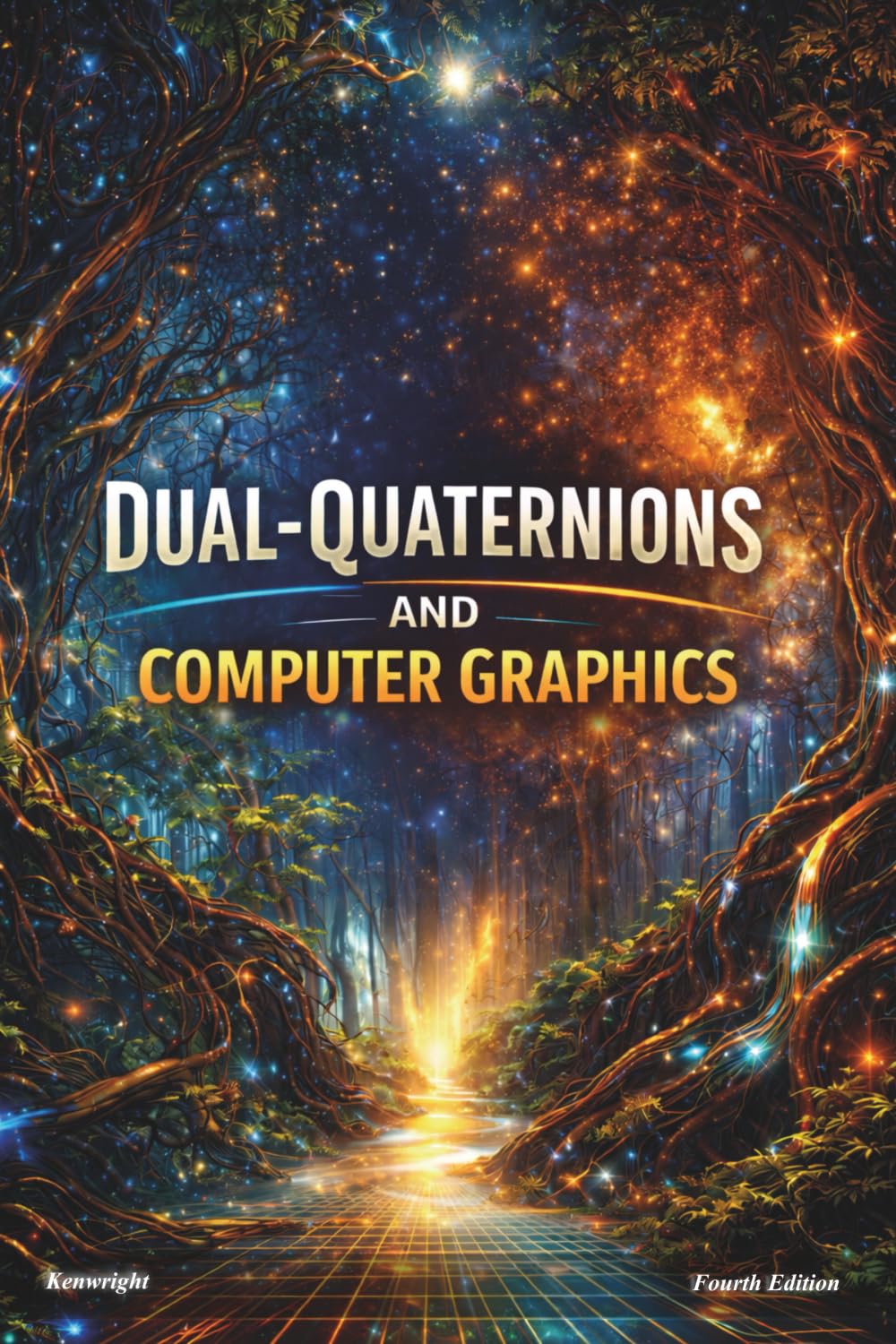
You are solving 21st-century problems with 20th-century mathematics—and it’s holding your entire field back. You’ve pushed matrices to their limit. You’ve twisted quaternions into every shape you can imagine. Yet deep in your systems, artifacts persist: the unsettling pinch in a character’s shoulder, the wobble in a smoothly interpolated camera path, the fundamental disconnect between how you think about motion and how your code represents it. You patch. You blend. You fudge. But the underlying truth remains: you are using tools designed for separate tasks to solve a unified problem. There is a crack in the foundation of how graphics represents reality. What if that crack wasn’t a flaw in your work, but a flaw in the very language you’ve been taught to speak? Dual-Quaternions and Computer Graphics is not a book about learning the maths. It is a manifesto for a paradigm shift . This book is for the architect, not the carpenter. For tthose who seek elegant solutions hiding behind a wall of workarounds. For those ready to weaponize a new mathematical primitive. For those who understands that the next leap in real-time graphics, physics, and procedural generation won’t come from faster hardware, but from a more profound understanding of space, motion, and transformation. Forget Optimization. Discover a New Primitive. The power of dual-quaternions is not in doing old things slightly better. It is in enabling new things altogether. This is not an incremental improvement. It is a change in category. You are no longer building with bricks and mortar. You are building with a new, programmable material that bends to your will without breaking. Watch the Paradigm Fracture and Re-form: The Old World: A fragmented toolkit. Matrices for transforms. Quaternions for rotation. Weighted averages for blending. A constant, silent war against shearing, gimbal lock, and volume loss. - The New World: A unified field. The pose of a robot, the frame of an animation, the deformation of a mesh—all are expressions of the same primal type. Problems of interpolation, smoothing, and constraint become elegant, one-line solutions. What You Will Actually Command: Not a set of techniques, but a new lens . When you finish, you will not see dual-quaternions as a solution to a known problem. You will see them as a source of new possibilities . You will recognize their potential in uncharted territories: Reimagining Skinning: Beyond fixing artifacts, to defining entirely new, volume-preserving deformation models. - Unifying Animation & Physics: Representing the state of a dynamic object from simulation through to render in one consistent, continuous data structure. - Spatial Generative AI: Providing a stable, continuous latent space for generating and manipulating 3D pose, shape, and motion. - Next-Gen Constraints & Solvers: Building more robust and intuitive systems for IK, rigging, and physical interaction. The old categories of “animation math,” “render transforms,” and “physics state” will dissolve. In their place, you will wield a single, coherent tool for describing and manipulating existence in space. The Inevitable Realization: This book is not the end of a journey. It is the discovery of a new continent. The established paths of linear algebra have been fully mapped. The landscape of dual-quaternions is vast, fertile, and largely untapped. The most powerful applications may not yet have names. You are not learning a technique. You are being handed the key to a new realm of creative and technical potential.
More Information
| Gtin | 09798247622772 |
| Age_group | ADULT |
| Condition | NEW |
| Gender | UNISEX |
| Product_category | Gl_book |
| Google_product_category | Media > Books |
| Product_type | Books > Subjects > Computers & Technology > Programming > Graphics & Multimedia |