
Description
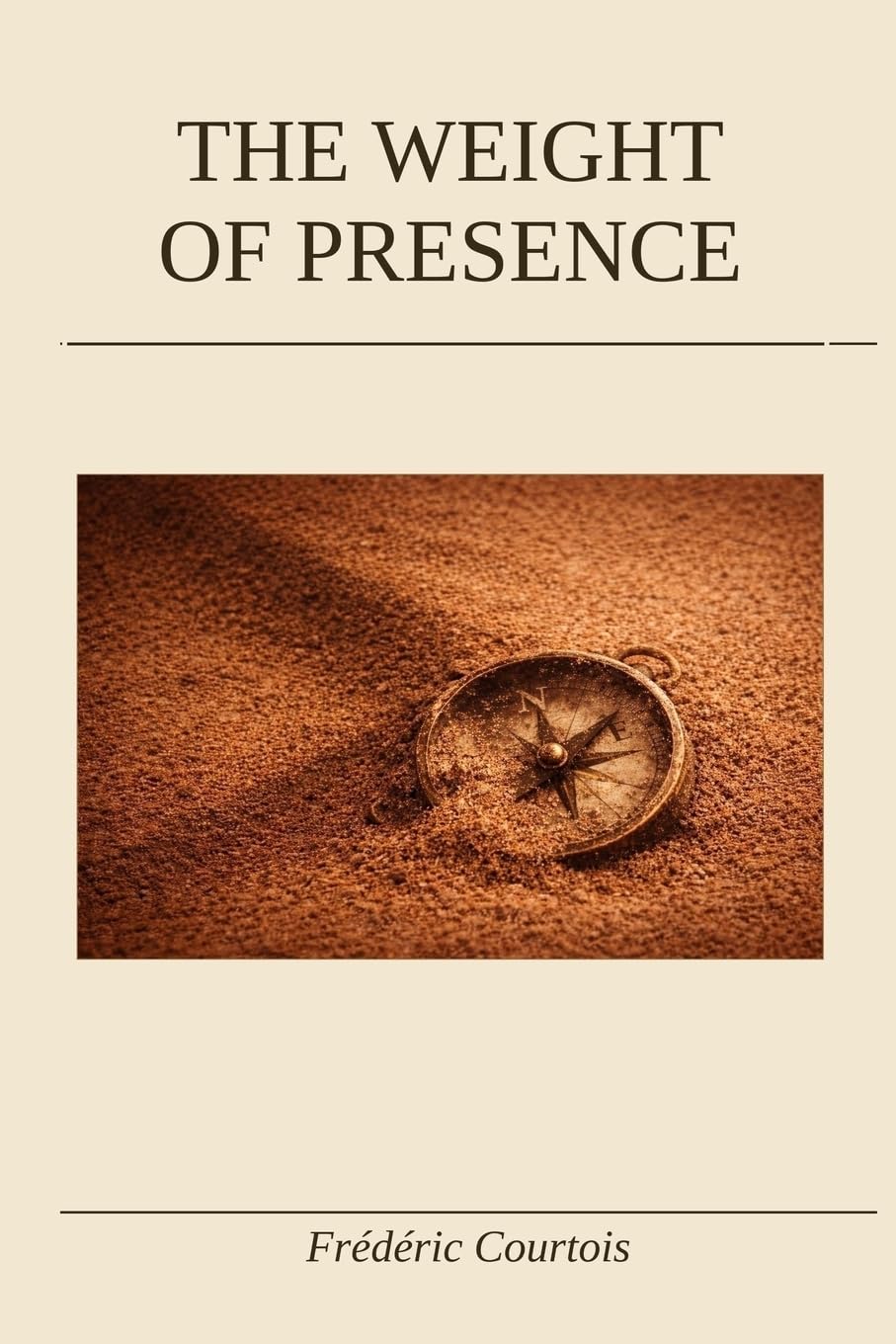
The Weight of Presence Frédéric Martin was born a bastard, his birth certificate stamped non reconnu , his father’s name absent. What followed was decades of crossing: borders, languages, institutions, the boundaries between survival and self-destruction. Linear lives move from wound to recovery, from broken to whole. This one refused that arrangement. The Weight of Presence traces one man’s passage through post-industrial France, the bohemian nights of Monterrey, the Appalachian mountains of West Virginia, and the high desert of New Mexico and Nevada. Each landscape a mirror, each departure a reckoning. Along the way, Martin encounters a series of unlikely teachers: a priest who stages a benevolent ambush, a dying coal miner in an ICU, an elder who presses his palm to the earth and says: your addiction and your healing are the same circle. This is the book’s central claim, and it is not metaphor. Drawing on Indigenous teachings, the philosophy of Sartre and Levinas, the magic realism of García Márquez, and twenty years working alongside people the world has rendered invisible, Martin argues that fractured lives, held whole in their highs and lows, become the most precise instruments for accompanying others through similar terrain. Presence is not a gift. It is a discipline. And wounds, if you learn to hold them, become a map, a compass. THE WEIGHT OF PRESENCE By Frédéric Courtois IR Rating: 5.0 Frédéric Courtois's debut novel THE WEIGHT OF PRESENCE is a touching, lucid account of one boy's search for definition. IR Approved Literary Fiction Posted by IR Staff - April 12, 2026 Frédéric experiences a childhood of neglect and wanders from country to country in search of meaning. It is a cliché to suggest that an immigrant is always an immigrant. Still more of a cliché to suppose that immigrants never feel quite at home, that a longing for one's homeland and all that comes with it forever colors their experiences. Frédéric Courtois's debut autobiographical novel THE WEIGHT OF PRESENCE certainly dallies with these points, but does so from an intriguing perspective: What happens when the immigrant in question never felt quite at home in the first place? Like Courtois, the novel's protagonist, Frédéric Martin, comes from near the Vosges in eastern France. He is a bastard, forever instilled with "the hollow feeling I carried but could not locate," and from a home in a run-down neighborhood populated mostly by Roma (in which his mother continues a vestigial, physically abusive relationship with his stay-away father). His childhood was disfigured by repeated, traumatic meetings with death: a good childhood friend, murdered; a grandfather passing suddenly after pouring out his heart about his times as a member of the French Resistance. Grief became, as he puts it, "the quiet thread" in his life. By the 1980s, Frédéric was growing up and became a wanderer, "trying to be nowhere in particular"—flitting on and off trains, hitchhiking, and the like. Before long the wanderlust brought him to America, where he worked on a Texas ranch, fetched up in Mexico, then Monterey, and the like. Frédéric's circumstances are related with Plathian detachment. Descriptions are elegant and crisp, the pacing unhurried and considered. Metaphors are densely layered, and frequently tie Frédéric to the events of his past—shielding his mother from concern, gaining an employment card based on a fictive background that only serves to place his actual lived experience in sharp relief. We're reminded that, in fact, everyone comes from somewhere—even when that somewhere appears to be nowhere. The constant movement from place to place, from one country to another, slowly dissolves into a sort of background hum. As the novel progresses, one starts to intuit that it's perhaps not the experience of being an immigrant that counts but the need to be one. How much of this is real is, of course, anyone's guess. That is autofiction's nature, and so many of the details here are purely incidental. But then again, that does feel like the point. Frédéric's is an incidental life, one embarked upon almost by accident. What he succeeds in doing is making it purposeful. His life is essentially one long act of becoming in spite of everything, and it's a remarkably validating experience to be along for the ride. Frédéric Courtois's debut novel THE WEIGHT OF PRESENCE is a touching, lucid account of one boy's search for definition. ~ Craig Jones for IndieReader
More Information
| Gtin | 09798995339908 |
| Age_group | ADULT |
| Condition | NEW |
| Gender | UNISEX |
| Product_category | Gl_book |
| Google_product_category | Media > Books |
| Product_type | Books > Subjects > Health, Fitness & Dieting > Addiction & Recovery > Alcoholism |