
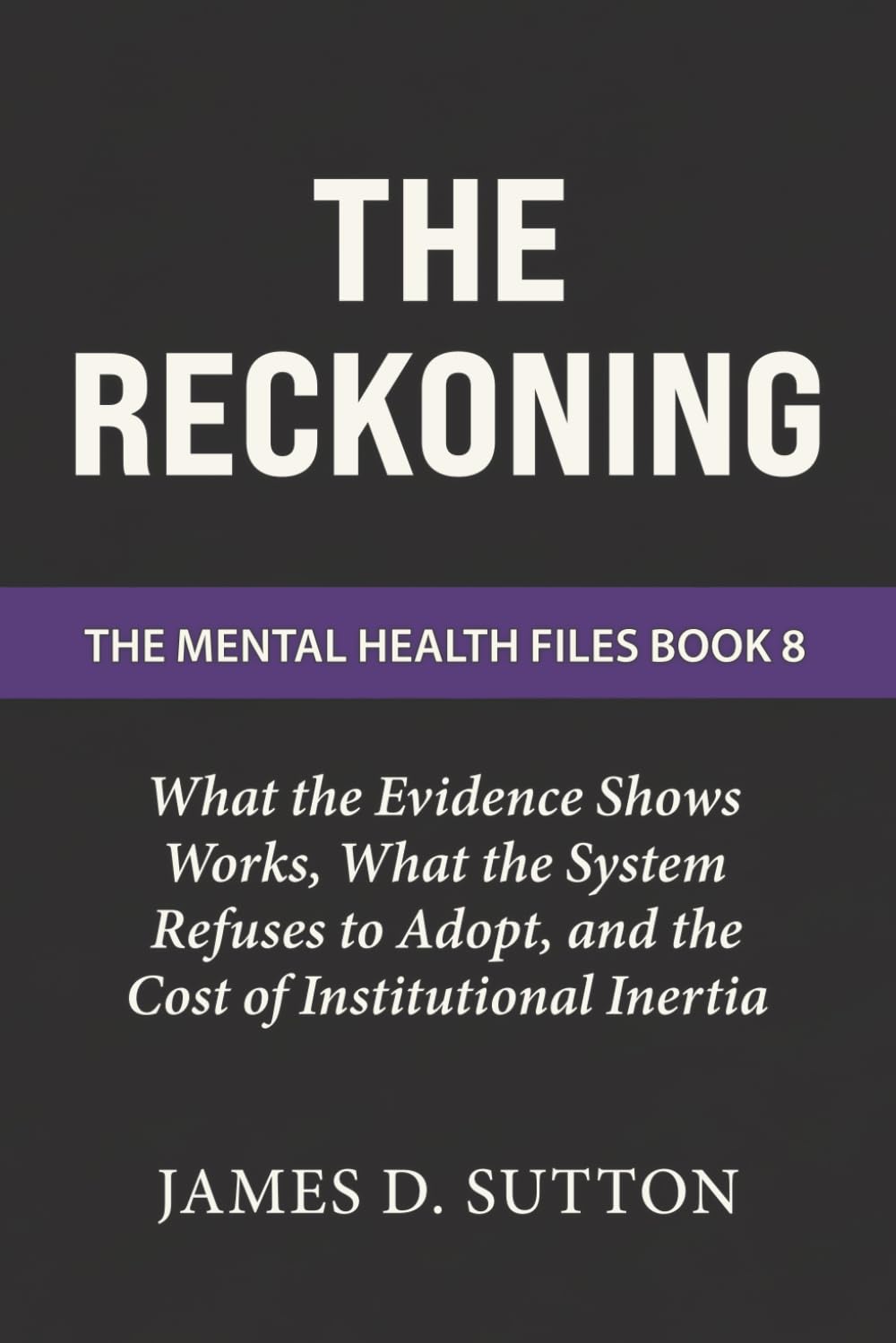
The Reckoning: What the Evidence Shows Works, What the System Refuses to Adopt, and the Cost of Institutional Inertia (The Mental Health Files)($19.99Value)
$19.99
The Reckoning: What the Evidence Shows Works, What the System Refuses to Adopt, and the Cost of Institutional Inertia (The Mental Health Files)($19.99Value)
Description
Four hundred and seventy-seven point five billion dollars. That’s the annual cost of mental health inequities in America—premature deaths, lost productivity, chronic conditions, emergency departments functioning as the nation’s psychiatric intake. By 2040, the figure reaches $1.26 trillion. Cumulative: $14 trillion. The numbers come from the system’s own records. The alternatives cost less. The Reckoning is the capstone of an eight-book investigation. Seven volumes documented the failures—the pharmaceutical pipeline and its $9.4 billion in DOJ settlements that changed nothing, the commitment system that cannot demonstrate its own effectiveness, the for-profit hospitals where the bed is the revenue, the troubled-teen industry that operated on children without federal oversight for decades, the preventable deaths in system-known cases, the access crisis measured in ER boarding hours and jail cells, the children who could not consent. This volume assembles the alternative. Six evidence-based treatment models with documented outcomes. Assertive Community Treatment—Cochrane-reviewed, hospital admissions reduced, cost of care invariably lower. Housing First—tested in the largest mental health RCT in history, 80–90% housing retention sustained over six years. Open Dialogue—82% of first-episode psychosis patients symptom-free at five years in the Finnish studies. Clubhouse—one year of recovery services for the cost of two weeks of psychiatric hospitalization. Peer support—certified in 49 of 50 states. Crisis stabilization—40,000+ episodes annually in Arizona’s comprehensive system. Italy abolished its psychiatric hospitals in 1978 and replaced them. Finland produced nineteen-year outcome data. England built the world’s largest mental health outcome measurement system—1.3 million patients per year, symptom scores collected at 98% of contacts, recovery rates published annually. The United States spends more per capita on mental health than almost any OECD nation. It measures less about what that spending produces than nearly all of them. The pharmaceutical industry spent $452 million on lobbying in 2025—number one among all industries since 2010. The fee-for-service billing architecture rewards the institutional arrangements the evidence-based models would displace. Twenty-nine states declined to accept 85% federal funding for mobile crisis teams. The system that does not track whether its patients recover has not built the workforce to staff the models the evidence supports. This investigation does not prescribe solutions. It presents evidence—from the system’s own records, from Cochrane reviews, from OECD benchmarks, from the Deloitte cost analysis, from the lobbying disclosures, from the international comparison. Every limitation acknowledged. Every scientific debate presented with both sides. The evidence is assembled. The reader assesses. The Mental Health Files is an eight-book investigative nonfiction series examining the institutional failures of the American mental health system. Each book investigates a different dimension. Each book stands alone. Each is built on the system’s own records. The Reckoning is the series capstone—the volume where the evidence from seven preceding investigations meets the evidence for what works, and the institutional question becomes unavoidable.
More Information
| Gtin | 09798255158447 |
| Age_group | ADULT |
| Condition | NEW |
| Gender | UNISEX |
| Product_category | Gl_book |
| Google_product_category | Media > Books |
| Product_type | Books > Subjects > Medical Books > Administration & Medicine Economics > Health Policy |