
Description
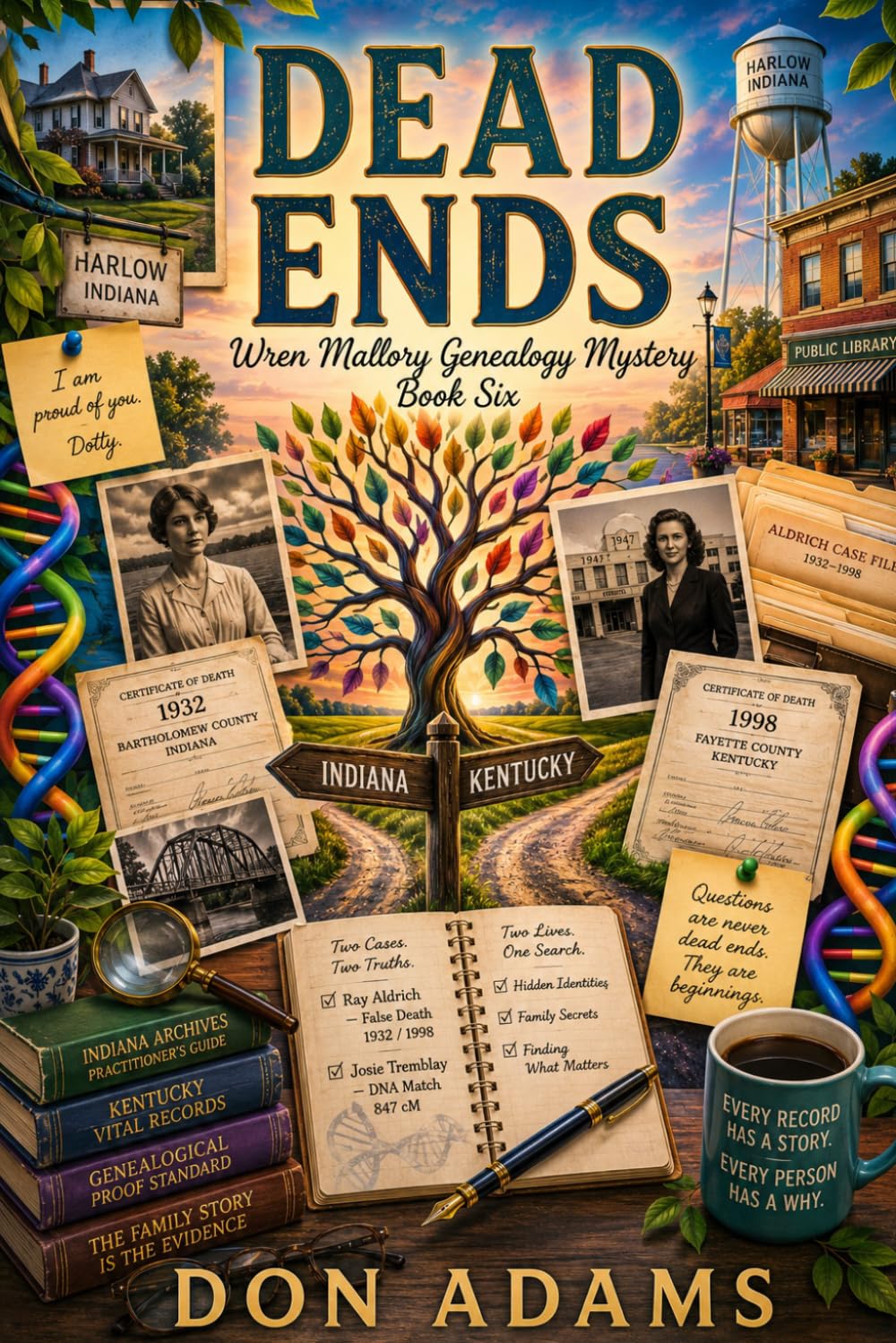
From the intake email that started the case: Ms. Mallory — My name is Ray Aldrich and I live outside Lexington, Kentucky. I was given your name by a woman named Helen Koger who said you did good work for her father. My grandmother, Vera Aldrich, drowned in the White River flood in southern Indiana in April of 1932. She was twenty-five years old. Her body was never recovered. She left behind two young children and a husband, and the county issued a death certificate based on the testimony of a single witness. The casket at her funeral was empty. The family was told there was nothing to bury. But my grandmother did not die in 1932. She died in 1998, in this house, at the age of ninety-one. I was with her when she passed. I have a photograph of her standing in front of a building in Lexington — a building that was not constructed until 1947. I would like to know why. — Ray Aldrich In six years of genealogical practice, Wren Mallory has built her career on DNA — the centimorgans that don't lie, the segment maps that resolve every paternity question, the genetic evidence that bridges strangers across closed adoptions and burned archives. But the Aldrich case has no DNA. It has a death certificate signed on the testimony of one man, an empty casket buried in 1932, and a photograph of a woman standing in front of a building that proves she was alive fifteen years after the state declared her dead. A woman doesn't fake her own death in 1932 without a reason. As Wren works backward through census records, property deeds, and the letters Vera Aldrich wrote to her cousin in Louisville, the reason begins to take shape — not in what the letters say, but in what they stop saying. A bruised arm. A husband's "opinions." A young mother who learned, line by line, to write around the truth until she found a way out of it. Meanwhile in Harlow, the heat of an Indiana July settles in. A twelve-year-old basset hound named Sanger negotiates his terms with the kitchen counter. Dotty's tomatoes come on early. A nervous young woman appears at Wren's gate with questions of her own. And Wren's landlord — silent for four years — suddenly wants to talk about the carriage house lease. Some cases are about who someone was . This one is about who someone had to become to survive. And as Wren follows Vera's path from a flood-plain farm in Bartholomew County to a farmhouse in Kentucky bought with cash, she begins to understand that the records aren't the answer. The records are the dead ends. The answer is in the spaces between them. Perfect for fans of: Cozy mysteries with an amateur female sleuth Historical mystery puzzles spanning multiple decades Cold case and "lost woman" mysteries Small-town settings with quirky, observant neighbors Dog-companion cozy mysteries (basset hound sidekick) Methodical, neurodivergent-coded detective protagonists Genealogy, archival, and family history mysteries Clean reads — no graphic violence, no on-page intimacy Series readers who love watching a protagonist's world quietly expand The Wren Mallory Genealogy Mystery series — where every family tree has a buried root, and every silence in the record means something.
More Information
| Gtin | 09798197412928 |
| Age_group | ADULT |
| Condition | NEW |
| Gender | UNISEX |
| Product_category | Gl_book |
| Google_product_category | Media > Books |
| Product_type | Books > Subjects > Mystery, Thriller & Suspense > Mystery > Women Sleuths |