
Description
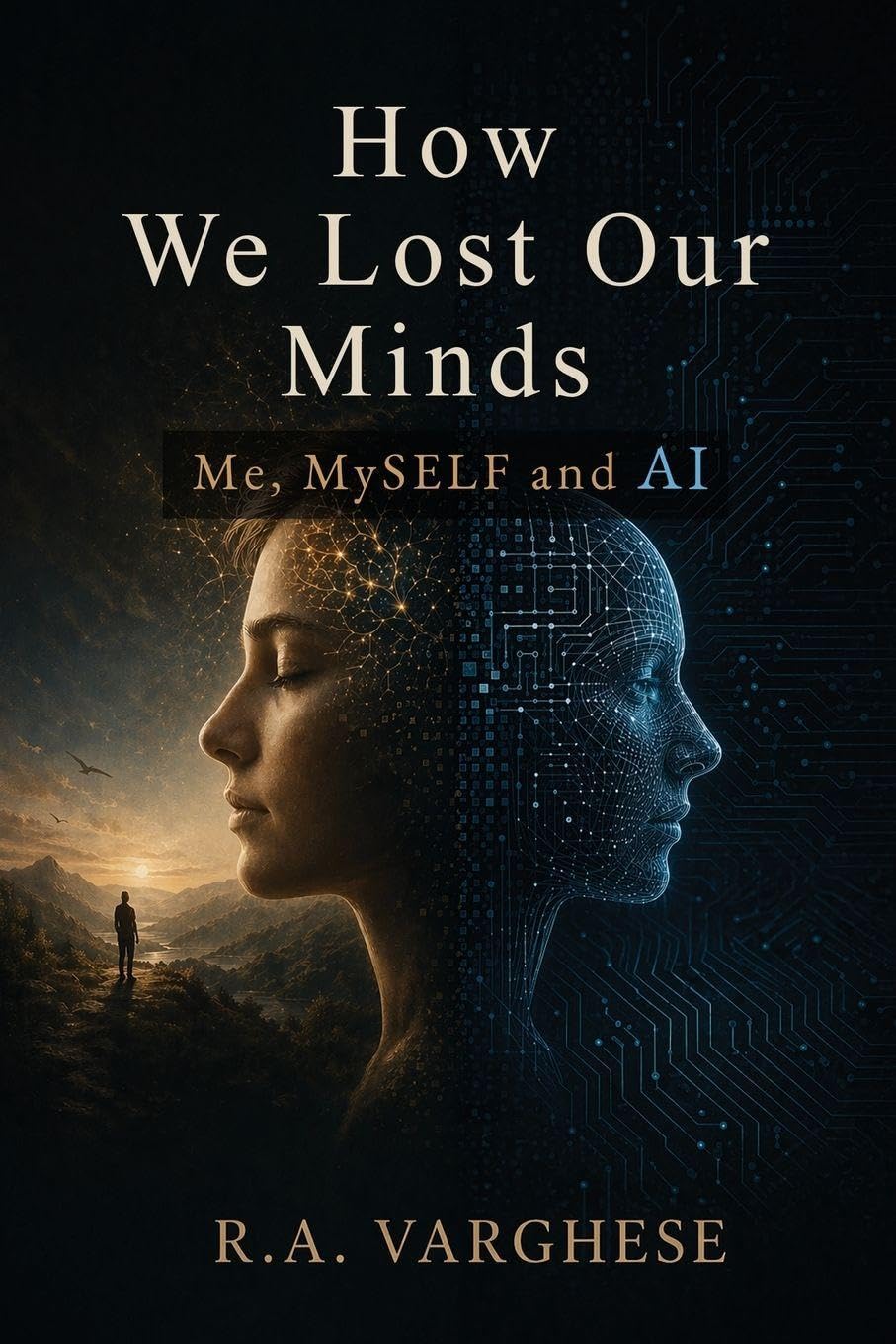
How We Lost Our Minds is a tale of two spells. On the one hand, we mistook brains for persons. On the other, we mistook machines for mortals. Can neural networks "know"? Are LLM chatbots conscious? Are humans "computers made of meat"? The answers are all here. Above all, as we will see, AI is an artifact of mathematics. As such, AI itself bears witness to a world beyond bits and bytes, ones and zeros. It is the world of mind affirmed by the greatest mathematicians of all time. Now, some 40 years after organizing a landmark Yale University conference on "Artificial Intelligence and the human mind" - with four Nobel Laureates and AI pioneers including Marvin Minsky of MIT, Doug Lenat of Stanford, and Hans Moravec of Carnegie-Mellon - author R.A. Varghese revisits the same newly relevant theme. With a focus on understanding, consciousness, and personhood in the context of neural networks, deep learning, large language models, world simulations, and intelligent agents, this book cuts through the hype to reveal what AI can and cannot do. "This spirited, unapologetically defiant book arrives just as the contest between human and artificial intelligence ramps up into one of the central concerns of our present-day culture. Framed as "a tale of two spells," Varghese's provocative work takes aim at the twin enchantments of the contemporary age: the idea that human beings are merely biological machines, and the growing popular conviction that machines are edging towards becoming persons. The discussions on language, meaning, and personhood are what power the book, especially when Varghese contrasts human understanding with the statistical pattern-matching that drives large language models. Varghese's sustained effort to recenter human uniqueness strikes a chord, reframing AI not as humanity's replacement but as proof of the power of human intellect itself. Ultimately, Varghese makes a persuasive, compelling case: consciousness, meaning, and personhood remain stubbornly, and wonderfully, human." Publisher's Weekly Comments on works by R.A. Varghese "Varghese explores the basic and critical questions we face concerning this remarkable and wonderful universe. Why are we here? Where are we going? This is no doctrinaire treatise, but a sensitive, profound and clear discussion of the important issues of our universe and our existence, including questions, answers, and uncertainties. It is written with a deep understanding of philosophy, spirituality, and the complex science involved, yet expressed in a way which is interesting and very understandable to the non-specialist." - Charles H. Townes, Nobel Prize winner and inventor of the laser "Though I found myself arguing with both protagonists, the issues raised and Guru's lucid outline of modern science's framework of understanding, helped me to challenge and refine my own answers to the ultimate questions that each one of us must ask." - Arno Penzias, Nobel Prize winner who discovered the Cosmic Microwave Background Radiation that established the Big Bang theory R.A. Varghese is the winner of a Templeton Book Prize and the author of various books on consciousness, mind and AI including The Missing Link and Metaverse of Mind. His widely acclaimed work Cosmos, Bios, Theos featured contributions from 24 Nobel Prize winners. In 1986, Varghese organized a conference at Yale University on the theme "Artificial Intelligence and the human mind." Participants included four Nobel Laureates (among them neural network leader Leon Cooper) and pioneers of AI ranging from Marvin Minsky of MIT and Doug Lenat of Stanford to Hans Moravec of Carnegie-Mellon. Stanford's AI Magazine covered the conference ("A Report from the Battlefields of the Mind-Body Problem," Volume 8).
More Information
| Gtin | 09798240950216 |
| Mpn | Refer To Sapnet. |
| Age_group | ADULT |
| Condition | NEW |
| Gender | UNISEX |
| Product_category | Gl_book |
| Google_product_category | Media > Books |
| Product_type | Books > Subjects > Computers & Technology > Computer Science > AI & Machine Learning > Natural Language Processing |