
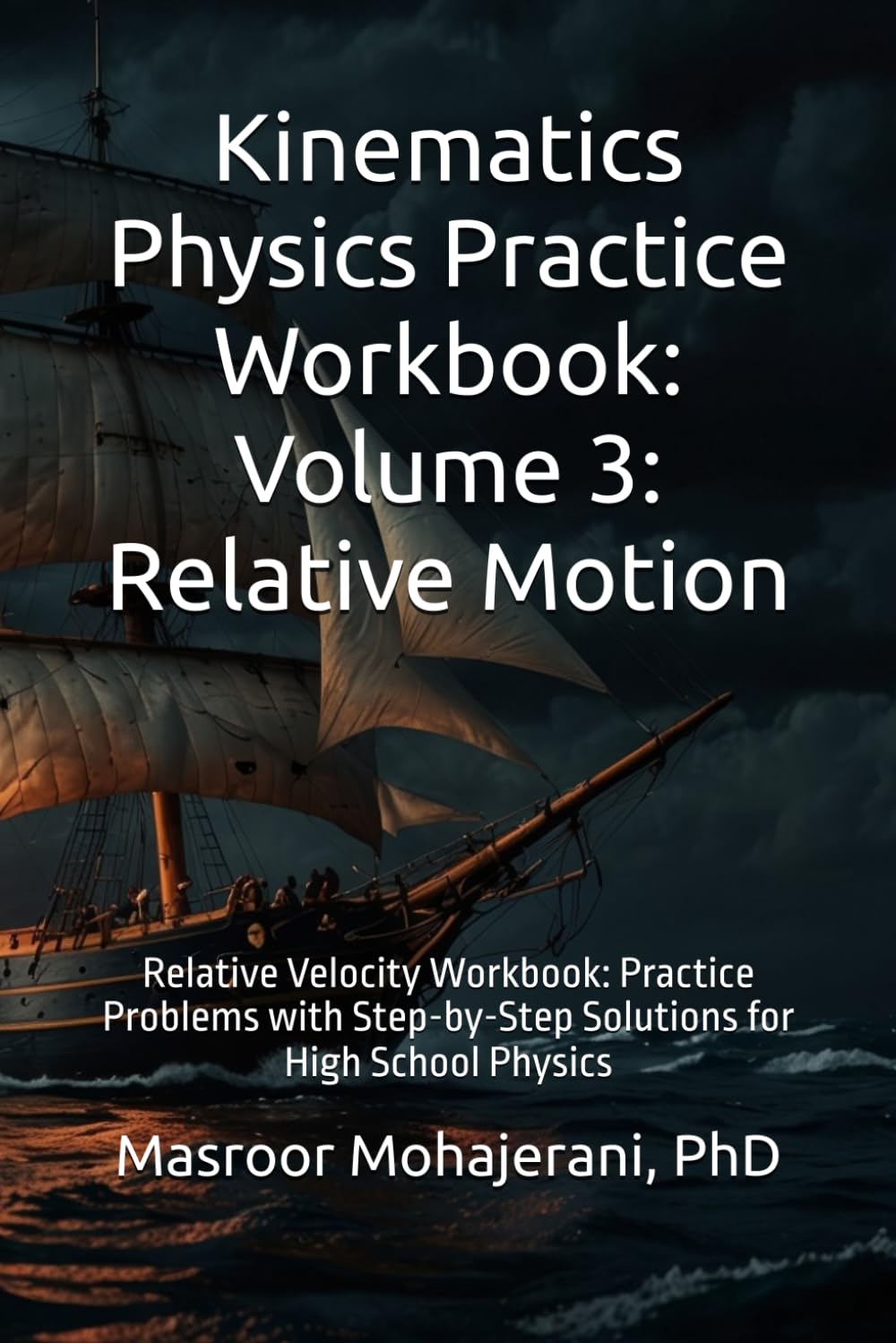
Kinematics Physics Practice Workbook: Volume 3: Relative Motion: Relative Velocity Workbook: Practice Problems with Step-by-Step Solutions for High($9.99Value)
$9.99
Kinematics Physics Practice Workbook: Volume 3: Relative Motion: Relative Velocity Workbook: Practice Problems with Step-by-Step Solutions for High($9.99Value)
Description
Motion is one of the most familiar experiences in everyday life. Cars move along highways, passengers walk through trains and airports, boats travel through flowing rivers, airplanes move through changing winds, and people observe the world from moving vehicles. Yet motion is not always as simple as it appears. An object may seem to move quickly to one observer and slowly, or not at all, to another. Understanding this difference is the purpose of relative motion. Kinematics Vol. 3: Relative Motion is designed to help students build a clear and practical understanding of how motion depends on the reference frame from which it is observed. The book introduces the essential ideas of relative position, relative velocity, and relative acceleration, then develops them through a wide range of carefully explained examples and practice problems. Its goal is not only to help students obtain correct answers, but also to show them why the equations work and how to organize their thinking in a consistent way. Relative motion is an important part of introductory physics because it connects mathematical concepts to real situations. A major focus of the book is the connection between clear diagrams, organized equations, and physical interpretation. Students are encouraged to identify the object, the observer, and the relevant reference frame before beginning a calculation. They then determine which velocities are known, which velocity is required, and whether the motion is one-dimensional or two-dimensional. This approach helps prevent common errors, such as adding speeds without considering direction, confusing the velocity of an object relative to the ground with its velocity relative to the air or water, or using an angle measured from the wrong direction. Each worked example is presented step by step. The solutions show how to translate a written situation into physics notation, choose an appropriate equation, substitute values with correct signs and units, calculate the magnitude of a velocity when necessary, and state the final direction clearly. The practice questions gradually move from direct applications of the main relative-velocity relationship to more challenging problems involving multiple moving objects, changing directions, river crossings, travel times, and heading adjustments. The book also emphasizes that relative motion is not merely a collection of formulas. It is a way of describing the same physical event from different points of view. Two observers may disagree about an object’s position or velocity, yet both descriptions can be correct because they are using different reference frames. When the reference frames move at constant velocity relative to one another, they measure the same acceleration even though they may measure different velocities. This idea provides an important bridge between basic kinematics and broader topics in physics. Students will benefit most by attempting each practice question independently before reading the full solution. Even when an answer is not obtained immediately, the process of identifying directions, drawing a simple vector diagram, and deciding which reference frame is most useful develops the habits needed for success in physics. Reviewing the worked steps afterward can reveal where an error occurred and how a more efficient method can be used next time. Kinematics Vol. 3: Relative Motion is intended for high school physics students, independent learners, tutors, and anyone who wants structured practice with one of the most useful applications of vectors in motion. By the end of the book, readers should be able to analyze relative-velocity situations with confidence, explain the meaning of their answers, and apply the same reasoning to new problems involving vehicles, aircraft, boats, currents, wind, and moving observers.
More Information
| Gtin | 09798185581339 |
| Age_group | ADULT |
| Condition | NEW |
| Gender | UNISEX |
| Product_category | Gl_book |
| Google_product_category | Media > Books |
| Product_type | Books > Subjects > Science & Math > Physics > Applied |